

Your Trusted Customized BIB Bag-in-Box Manufacturer for Premium Packaging Solutions
2026-05-17
When you need packaging that protects product integrity and elevates your brand, standard solutions rarely suffice. Bag-in-Box technology offers unmatched convenience and sustainability, yet the true differentiator lies in customization. Enter Kody—the trusted manufacturer that turns your unique requirements into premium BIB packaging. From material selection to dispensing fitments, we craft solutions that fit your business like a glove. Read on to discover how customized BIB can transform your product's journey.
Crafting Tailor-Made BIB Packaging to Fit Your Brand
When your brand embraces bag-in-box packaging, every detail becomes an extension of your identity. From the shape of the bag to the curve of the spout, custom designs ensure your product sits comfortably in the hands of your customers. It's not just about containment—it's about creating a tactile experience that reinforces your story at every pour.
Beyond the structural choices, graphic elements and material finishes offer nearly limitless opportunities to stand out. A matte or gloss laminate can reshape perceived value, while strategically placed transparent windows build trust by previewing the product inside. Color fidelity and print clarity transform a simple box into a shelf presence that speaks without words.
Even the functional aspects can be tailored to align with how your audience interacts with the product. Whether you need a compact design for travel-friendly portions or a high-volume fitment for commercial service, the adaptability of BIB packaging means your brand doesn't compromise. Every fill, seal, and closure is an opportunity to turn utility into a signature detail.
Why Our Bag-in-Box Solutions Outperform the Rest
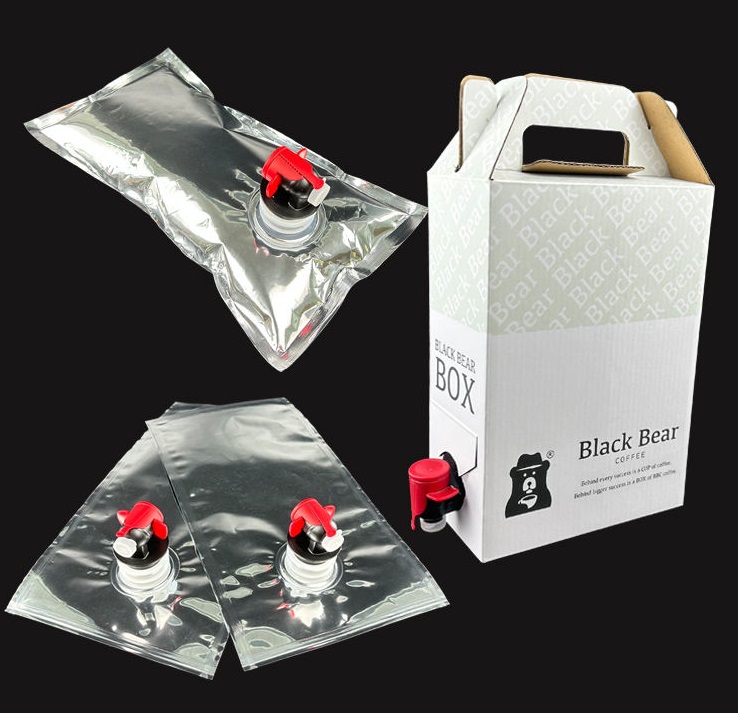
When we set out to design our bag-in-box systems, we didn’t just aim to check boxes on a spec sheet. We actually talked to the people who use them every day—the brewers, the winemakers, the syrup producers—and asked what drives them nuts about the alternatives. Turns out, most headaches come down to a few avoidable flaws: inconsistent dispensing, slow oxygen creep that dulls flavor, and packaging that feels wasteful. So we rebuilt the core components from scratch, focusing on the film’s multilayer barrier, the precision of the fitment, and the tap’s flow dynamics. The result isn’t magic—it’s just honest engineering that keeps product fresher longer and makes pouring effortless, even down to the last glass.
Material choice is where many suppliers cut corners, but we went the opposite direction. Our inner films use a proprietary blend that locks out oxygen at numbers others only dream of, without relying on thick, rigid laminates that crack under pressure. That means your product stays vibrant, whether it’s a delicate wine or a viscous cold-brew concentrate. And because we care about what happens after use, we’ve structured the box and bag to separate cleanly, so recycling isn’t a puzzle. Our approach reduces waste not as a marketing bullet point, but because it simply makes sense—less material, smarter design, better performance.
In the field, our customers notice the difference in real terms: fewer complaints about off-tastes, fewer clogged taps during high-volume service, and a smoother workflow from fill to dispense. We didn’t reinvent the wheel; we just stopped tolerating the small imperfections that add up over time. That’s why we back every system with unequaled support—because when the engineering is solid, the promises are easy to keep.
From Concept to Delivery: Our Seamless Production Process
It starts with an idea, often sketched on a napkin or discussed over coffee. We take that raw concept and flesh it out through a series of collaborative workshops, where our engineers and designers challenge assumptions and refine the vision. Prototyping happens early—rough models that we can touch, test, and break—so we learn what works before committing to expensive tooling. This iterative loop between imagination and tangible mock-ups ensures the final product isn’t just feasible, but genuinely useful.
Once the prototype proves itself, we move into the nitty-gritty of production planning. Materials are sourced not just for cost, but for durability and supply chain resilience. Every step on the factory floor is mapped out to minimize waste and avoid bottlenecks. Our teams work in tight sync, so if a machine hiccups or a supplier runs late, adjustments happen in real time—not after a crisis has already unfolded. It’s a living process that balances efficiency with the flexibility to adapt.
Finally, the finished units roll off the line and into a meticulous quality-check gauntlet. We don’t just spot-check; we simulate real-world use, sometimes pushing products beyond their rated limits. Packaging is designed to protect during transit while being easy to unpack without a wrestling match. From there, it’s into the logistics network, with tracking that keeps you in the loop until the moment it arrives at your door. No drama, no excuses—just a product that matches the vision you had at the start.
Uncompromising Quality for Sensitive Liquid Products
Handling sensitive liquids demands a level of rigor that mass-market packaging simply ignores. We focus on materials that resist chemical interaction, using liners and seals that won’t degrade or leach when in contact with aggressive formulas. Every batch undergoes pressure tests and accelerated aging to ensure container integrity long after it leaves the warehouse. This isn’t about meeting broad standards—it’s about anticipating failure points that most audits miss.
Our production environment operates under protocols usually reserved for sterile pharmaceutical lines. Temperature and humidity are monitored continuously, and all contact surfaces undergo a two-stage cleaning between runs. These measures prevent contamination that could alter product stability, a risk that becomes catastrophic when dealing with ultra-pure or reactive liquids. The result is packaging that behaves more like a scientific instrument than a commodity.
Clients who work with us quickly notice the absence of surprises. Lot-to-lot consistency is tracked with spectrophotometry and viscometry data, not just visual checks. That data follows every shipment, giving technical teams a thread of accountability that standard suppliers rarely provide. For sensitive liquids, quality isn’t a feature—it’s the only variable that keeps a product viable.
Real-World Success Stories of Our Packaging in Action
From a bustling bakery in Portland to a boutique skincare brand in Austin, our packaging has quietly transformed daily operations. One small business owner told us switching to our compostable mailers cut their waste output by 40% — a change their eco-conscious customers immediately noticed and appreciated.
Another client, a subscription spice startup, struggled with leaky pouches that ruined entire shipments. After adopting our reinforced, resealable bags, their complaint rate dropped to nearly zero. That shift didn't just save product; it rebuilt trust with subscribers who now rave about the fresh, aromatic deliveries.
These moments aren't outliers — they're the result of designing with real challenges in mind. Whether it's fragile ceramics surviving cross-country transit or frozen foods staying solid through a heatwave, the proof is in the unboxing. And that's where a package stops being a box and starts being part of a story worth telling.
Sustainable Bag-in-Box That Shrinks Your Carbon Footprint
Every stage of a product’s journey—from raw material extraction to disposal—leaves a carbon trail. Traditional rigid containers demand more energy to produce, transport, and recycle, often relying on heavier materials and inefficient shapes that waste space. Bag-in-box packaging flips this model by prioritizing lightweight construction and a collapsible design. The inner bag and outer box weigh significantly less than glass or rigid plastic, which means fewer emissions during manufacturing. But the real climate advantage kicks in when these slim, stackable packages move from factory to shelf: more units per shipment translate directly into lower fuel consumption per liter of product delivered.
The secret lies in the structure. A bag-in-box uses a flexible, multilayered inner pouch paired with a corrugated cardboard shell, reducing total material volume by up to 75% compared to a standard rigid bottle. During transport, the empty boxes can be shipped flat to the filling site, slashing truckloads and the associated greenhouse gases. Once filled, the compact rectangular shape maximizes pallet efficiency, so a typical truck can haul up to 40% more product than when carrying round bottles. For brands that distribute over long distances, this density gain alone can knock double-digit percentages off their logistics carbon footprint, all without compromising shelf life or product protection.
Waste becomes a resource in the bag-in-box lifecycle. The outer cardboard shell is widely recyclable in standard paper streams, and the inner bag—often polyethylene or a high-barrier film—can be recycled through specialized programs or converted into energy in modern waste-to-energy facilities, depending on the local infrastructure. Some manufacturers are now developing mono-material inner films that are easier to recycle, closing the loop further. By choosing this packaging, companies not only cut emissions from production and transport but also support a future where packaging materials circulate rather than clog landfills. It’s a pragmatic shift that intertwines operational efficiency with genuine climate responsibility.
FAQ
Bag-in-Box is a packaging method that combines a flexible inner bag with an outer corrugated box. It's widely favored because it extends shelf life, reduces storage space, and dispenses easily through a tap or pump. The design also minimizes oxygen exposure, keeping products fresher for longer compared to rigid containers.
We don't just offer size and print variations. Our team collaborates early in the design phase to tailor every component—film structure, barrier layers, fitment types, and even the box's structural strength—to match your specific product, filling line, and distribution environment. This end-to-end involvement avoids common compatibility issues down the road.
While traditional uses like wine and dairy are obvious, we've seen strong demand from niche sectors such as cold brew coffee, liquid eggs, industrial lubricants, and high-value cosmetic ingredients. Our high-barrier films and aseptic options open doors for products that demand strict purity and long ambient stability.
It starts with understanding your product's chemistry and shelf-life targets. We then recommend film combinations and fitment sizes, produce lab-scale prototypes for compatibility testing, and run a small trial on your filling equipment. After validation, we scale to full production, with continuous quality checks from raw material receipt to finished goods dispatch.
Every film lot undergoes oxygen and moisture transmission testing, seal-strength checks, and micro-leak detection. We also simulate real-world stresses—vibration, temperature cycling, and drop tests—on the complete BIB unit. Certifications like ISO 22000 and BRC are maintained, but our real edge is a culture of traceability from polymer supplier to final pallet.
We actively reduce material usage through thinner yet stronger films that still meet barrier requirements. The bag is collapsible, cutting transportation volume. Many configurations are recyclable where facilities exist, and we're investing in mono-material structures that simplify recycling streams. It's a continuous push—lighter weight, less waste, same protection.
Conclusion
When you need packaging that truly represents your brand, settling for off-the-shelf options isn’t an answer. We build every Bag-in-Box solution from scratch, tailoring each detail—from barrier films to tap designs—to match your product’s personality and performance demands. This focus on customization means your packaging doesn’t just contain liquids; it communicates your promise of quality. And because we’ve refined our approach over years of iterative design and testing, our BIB systems consistently outperform generic alternatives in durability, dispensing precision, and shelf life extension. Behind that reliability is a production journey that flows without friction: our team walks with you from initial concept sketches through prototyping and all the way to final delivery, keeping timelines tight and communication open.
What truly sets us apart is our refusal to compromise on quality, especially for sensitive liquids like wines, juices, and dairy products that demand oxygen-barrier protection and aseptic filling. We’ve seen these safeguards translate into tangible wins for clients—dairies reducing spoilage by double digits, vineyards preserving delicate aromas far longer than expected. Our packaging doesn’t just perform; it also respects the planet. By engineering lighter-weight films, optimizing box designs for flat shipment, and utilizing high-yield recycling streams, our Bag-in-Box solutions actively shrink your carbon footprint without sacrificing strength. We don’t see sustainability as a checkbox—it’s woven into how we source materials, design disposability, and help you meet the eco-conscious expectations of today’s consumers.
Contact Us
Contact Person: Cindy Lee
Email: [email protected]
Tel/WhatsApp: 8613622669331
Website: https://www.dgkody.com