

Shuttle Rotomolding Machine Solutions Boost Manufacturing Efficiency
2026-11-16
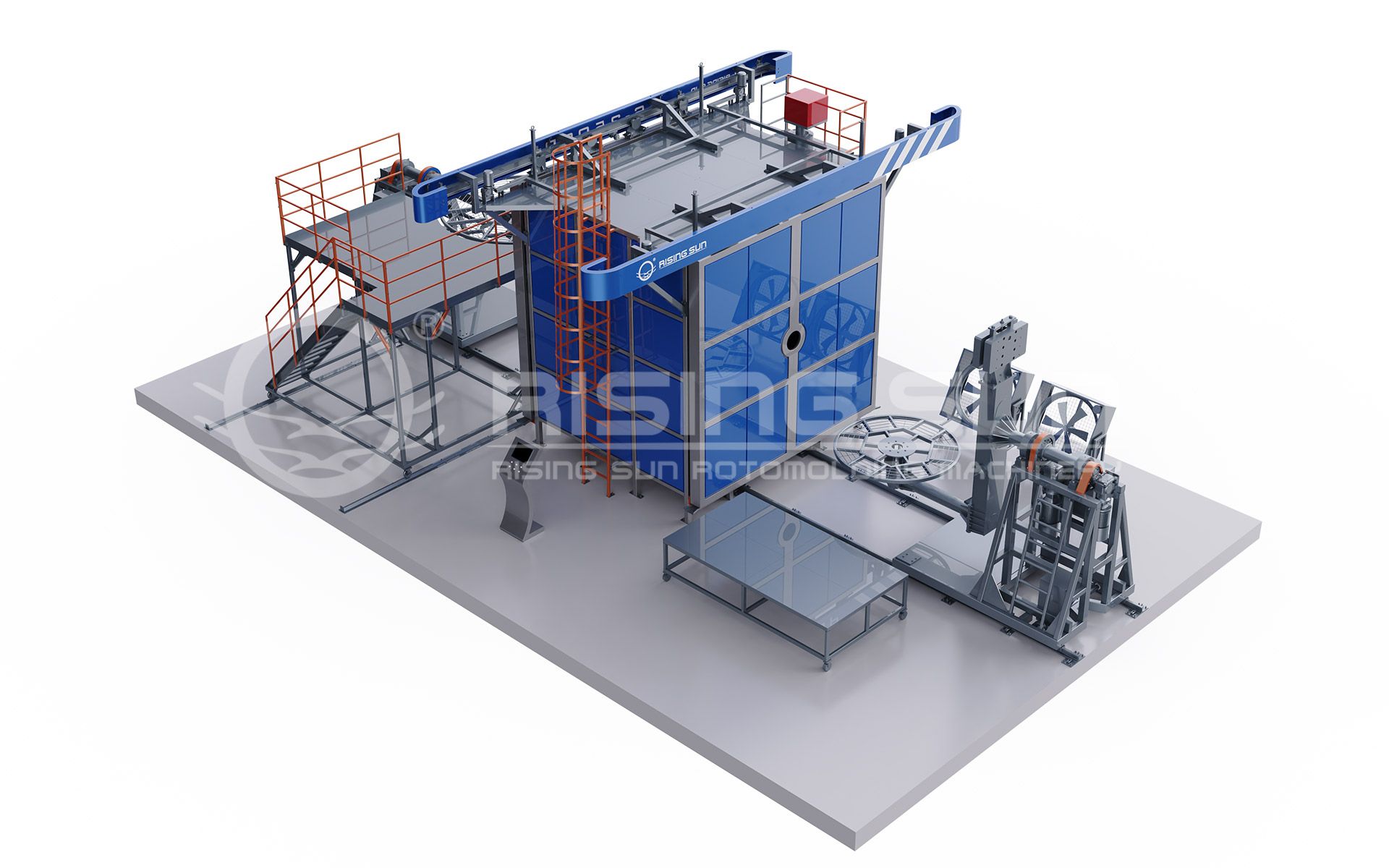
Shuttle rotomolding machines have a way of making traditional single-station setups feel suddenly outdated. Instead of waiting for one mold to cool while the oven idles, these systems keep heat, motion, and labor in constant rotation—cutting cycle times and energy waste in one move. At Rising Sun, we've seen the shift firsthand: operators handle multiple molds with less downtime, and complex parts come out with tighter walls and fewer rejects. But efficiency gains only show up when the shuttle system is matched to your actual part mix and floor layout. In this post, we'll break down what actually moves the needle—and where most shops still leave capacity on the table.
How Dual-Station Shuttle Molds Cut Cycle Times Nearly in Half
Dual-station shuttle molds operate by using two identical mold cores mounted on a single moving platen, allowing one core to remain in the injection position while the other is ejected and prepared for the next shot. This parallel operation eliminates the dead time normally spent waiting for part cooling and ejection. As soon as the first cavity is filled and cooled to the ejection temperature, the shuttle slides sideways, moving the second core into the injection station while the first part is removed. The press never waits for an entire cycle to finish before starting the next one.
The time savings come from overlapping cooling and part removal with the injection and plastication phases. In a conventional single-station mold, the injection unit sits idle during cooling, ejection, and mold open/close. With a shuttle design, the injection unit is active almost continuously, switching between the two cores. For many applications, this cuts overall cycle time by 40 to 50 percent without increasing clamp force or machine size. The mold itself becomes slightly wider due to the shuttling mechanism, but the footprint increase is minor compared to the productivity gain.
Shuttle molds are especially effective for parts with relatively long cooling times, such as thick-walled components or parts made from engineering resins. They also reduce the need for a robot or operator to wait at the press, since part removal happens on the non-injection side while the next shot is already running. Tooling costs are higher than a single-cavity mold, but significantly lower than a full two-cavity stack mold, and the cycle-time reduction often pays back the investment within months for high-volume production.
Reducing Labor Bottlenecks with Automated Cart Transfer
In many production and warehouse environments, the movement of carts between stations quietly becomes a major source of delay. Workers often spend significant time pushing heavy loads across long distances, which takes them away from value-adding tasks like assembly, picking, or quality checks. Automated cart transfer systems address this by taking over the repetitive transport work, ensuring materials arrive exactly when and where they are needed. This reduces idle waiting at downstream stations and lets skilled employees focus on the work that actually requires their judgment and dexterity.
Rather than hiring additional staff to cope with peak periods or to cover for absent cart handlers, facilities can rely on autonomous carts that run without breaks or shift changes. These systems can navigate around obstacles, follow optimized routes, and sync with production schedules in real time. The result is a smoother flow of goods, fewer traffic jams in aisles, and the elimination of the manual cart queue that often forms at busy intersections. Over time, the reduction in walking and pushing also lowers physical strain on workers, cutting down on fatigue-related errors and turnover.
Implementing automated cart transfer does not mean replacing the entire workforce; it means redirecting human effort toward more complex, high-value activities. A single operator can oversee multiple carts from a central interface, intervening only when an exception occurs. This shift changes the role of material handling from a full-time physical job to a supervisory one, which is easier to staff and scale. For many operations, the biggest gain is not just speed but consistency, since automated carts follow the same reliable pattern hour after hour, removing the variability that often creates bottlenecks in the first place.
Why Shuttle Rotomolding Outperforms Fixed-Arm Systems for Multi-Product Lines
Fixed-arm rotomolding machines have their place, but once a production floor starts juggling more than a couple of mold shapes, the limitations become obvious. A fixed arm locks you into a single swing diameter and oven profile, which means every new product either has to fit that geometry or you’re forced into costly retooling. Shuttle systems sidestep this entirely: the arms move independently between heating, cooling, and service stations, so one line can run a large water tank, a small medical cart base, and a playground slide without anyone re-engineering the machine. Operators can load and unload at one station while another mold is cooking or cooling, which keeps the line moving instead of waiting for a full cycle to finish.
The real difference shows up in changeover time. With a fixed-arm design, switching from a deep, narrow mold to a wide, flat one often means adjusting the arm’s radius, rebalancing the oven airflow, or even swapping out the entire carriage. Shuttle machines let you park different molds on separate carts and roll them in and out as needed—no arm repositioning, no recalibration. That flexibility matters when you’re running short batches or custom work. Instead of dedicating one machine to one product family, a shuttle line becomes a shared resource that adapts to whatever the schedule throws at it, without sacrificing cycle consistency.
There’s also a less obvious advantage: thermal stress on the machine itself. Fixed arms cycle through the same high-heat zone repeatedly, and over time that uneven thermal expansion can cause bearing wear or arm sag. Shuttle systems spread the work across multiple stations, so no single component sits in the oven longer than necessary. For plants that run multiple shifts, that translates into fewer unplanned maintenance windows and less drift in mold positioning. When you’re producing three or four different products on the same line, the last thing you want is a machine that is slowly baking its own alignment out of spec.
Trimming Material Waste Through Precision Heating and Cooling Zones
In injection molding and thermoforming, uniform heating of the entire mold or sheet often creates unnecessary thermal stress in areas that don't require deformation. By splitting the heating surface into independently controlled zones, engineers can apply intense heat only where the material must flow or bend, while adjacent regions stay relatively cool. This precision prevents edge degradation, scorching, and excessive thinning near the gate—common sources of scrapped parts that quietly erode material yield.
Cooling is just as critical. Uneven cooling rates across a part cause differential shrinkage, warpage, and internal stresses that force dimensional rejects. Instead of running a single coolant temperature through the whole tool, zoned cooling channels let you slow down heat extraction in thick sections and accelerate it in thin ribs or bosses. The result is a more uniform thermal contraction profile, which translates directly into fewer warped housings, brackets, or structural components being tossed into the regrind bin.
The real lever for waste reduction comes from linking these zoned thermal controls to process feedback. Thermocouples embedded in each zone, combined with a lightweight thermal simulation of the part geometry, allow the system to adjust heater outputs or valve positions on the fly. When a hot spot drifts toward a thin wall, the controller dials back that zone's wattage before the material degrades. This closed-loop approach avoids the trap of over-engineering the tool with too many tiny zones, which adds cost without measurable scrap savings. The goal is not precision for its own sake, but a practical zoning strategy that keeps every gram of feedstock inside the finished part.
Energy Savings That Come from Shorter, Smarter Oven Dwell Times
A conventional oven typically runs for a fixed period regardless of how the food inside is actually cooking, which means it often stays hot long after the job is done. That lingering heat isn't free—it draws power the whole time, pushing up energy use in ways most people never notice. By shifting to ovens that adjust their active heating cycles based on real-time internal conditions, you can cut that waste dramatically. The idea is simple: stop heating when the food no longer needs it, and start again only when the temperature drops below a useful threshold.
Shorter dwell times also reduce the frequency of one of the biggest energy drains in any kitchen—the open door. Every time someone opens an oven to check on a roast or a tray of baked goods, a wave of heat escapes and the appliance has to work harder to recover. Smarter ovens with better internal sensors and more even heat distribution make those checks less necessary. When the cavity holds temperature more consistently and the controls give a clearer picture of doneness, you trust the machine enough to leave the door closed, and that alone trims a meaningful slice off your electricity or gas bill.
The savings aren't theoretical. In a busy commercial kitchen, cutting average oven dwell time by just three or four minutes per batch across dozens of daily cycles can show up as a noticeable drop in monthly utility costs. For a home cook, the impact is smaller but still real—less heat lost to the kitchen means the air conditioner doesn't have to fight as hard in summer, and the oven's heating elements get fewer total hours of wear. It's a quiet kind of efficiency that adds up without requiring anyone to change how they cook, only how long the oven thinks it needs to stay on.
Real-World Production Gains: From 12 to 20 Cycles per Shift
When the team on Line 4 first heard about the target of 20 cycles per shift, more than a few eyebrows went up. The old rhythm sat at 12 cycles—steady, predictable, and deeply ingrained in muscle memory. But steady wasn’t enough anymore. By rethinking the tool-change sequence and moving a visual inspection step earlier in the cycle, operators stopped waiting on idle spindles and started catching defects before they became downtime. The shift didn’t happen overnight; it took three weeks of small, deliberate adjustments. By the fourth week, the line hit 18 cycles. By the sixth, 20 became the new normal—and the team stopped counting it as a stretch goal.
What mattered most wasn’t a single big fix but a stack of unglamorous ones. A sensor relocation here, a clamp reposition there, a slight change to how parts were staged at the station. Each tweak shaved seconds. Those seconds compounded into full cycles. One operator, a fifteen-year veteran, said the biggest change was psychological: once 15 cycles felt easy, 18 felt possible, and 20 felt inevitable. The data backs it up—scrap rates didn’t climb, and the extra output came without adding headcount or lengthening the shift.
Other lines took notice. The same principles that worked on Line 4—observing where hands and machines waited, then removing the wait—are now being tested on two neighboring lines. Early results show one line already at 16 cycles, up from 11. The lesson isn’t about pushing harder; it’s about finding the hidden pauses that everyone had learned to ignore. Those pauses were the real cost, and they were hiding in plain sight all along.
FAQ
They allow independent heating and cooling stations, so multiple molds can cycle simultaneously without waiting for a single central arm to rotate, cutting cycle times significantly.
By moving molds between dedicated heating and cooling zones in a linear path, the temperature profile stays uniform, reducing warpage and eliminating the uneven cooling common in older rotary setups.
Producers of large hollow parts like water tanks, kayaks, automotive ductwork, and agricultural containers see the biggest gains because the shuttle design handles oversized molds with better floor-space utilization.
Yes, the independent shuttle carts can be configured with different mold mounting plates, so a single line can switch between small and large parts without major retooling.
Since heating and cooling stations are separate and only active when a cart is present, energy isn't wasted keeping an entire oven hot for idle molds, reducing overall gas or electric consumption.
Operators can load and unload one cart while another is heating or cooling, so there are fewer manual mold transfers and less downtime between cycles.
Absolutely, the modular carts and quick-change mold attachments let manufacturers switch part designs rapidly, making them ideal for custom or short-run orders without sacrificing efficiency.
The linear rail system and separate heating/cooling zones mean fewer moving parts than a carousel, so wear is concentrated in easily accessible carts and seals, simplifying routine upkeep.
Conclusion
Shuttle rotomolding machines are changing how manufacturers approach rotational molding by addressing the two biggest constraints in the process: cycle time and labor. The dual-station shuttle design allows one mold to heat while the other cools or unloads, effectively cutting total cycle time nearly in half compared to single-station setups. This isn't just theoretical—plants that once struggled with idle operators and extended oven dwell now keep both stations working in parallel. Adding automated cart transfer removes the manual pushing and repositioning that typically creates bottlenecks, especially when operators juggle multiple molds of different sizes. For shops running diverse product lines, this setup outperforms fixed-arm systems because the shuttle can be programmed to run different mold profiles on each side without lengthy changeovers. The result is smoother workflow, fewer delays waiting for a single oven to finish, and a production line that adapts to order changes without sacrificing throughput.
Beyond speed, these machines trim material waste through precision heating and cooling zones that target exactly where the mold needs thermal input or extraction. Instead of overheating the entire mold to compensate for cold spots, operators can set distinct temperature profiles for different sections, reducing resin degradation and powder loss. Shorter, smarter oven dwell times also mean the burners run less frequently and the overall energy draw per part drops noticeably. In real-world applications, manufacturers have moved from 12 cycles per shift to 20 cycles per shift using the same floor space and crew size. That jump translates directly to more parts out the door without adding headcount or expanding the facility. For any rotomolding operation looking to increase output while controlling labor and material costs, shuttle machine solutions offer a practical, measurable path forward.
Contact Us
Contact Person: Sharon Zhu
Email: [email protected]
Tel/WhatsApp: 8615712666272
Website: https://www.risingsunroto.com