Motorcycle Parts Vertical Lift Plating Equipment Manufacturers: A Guide to Advanced Coating Solutions
2026-10-17
When it comes to coating motorcycle parts, precision and durability are non-negotiable. Vertical lift plating equipment has become a game-changer for manufacturers seeking advanced coating solutions that handle complex geometries with ease. In this guide, we explore how Junda and other leading manufacturers are pushing the boundaries of plating technology—delivering consistent finishes, reducing waste, and meeting the demands of high-performance motorcycle components.
Why Vertical Lift Plating Suits Irregular Motorcycle Part Geometries
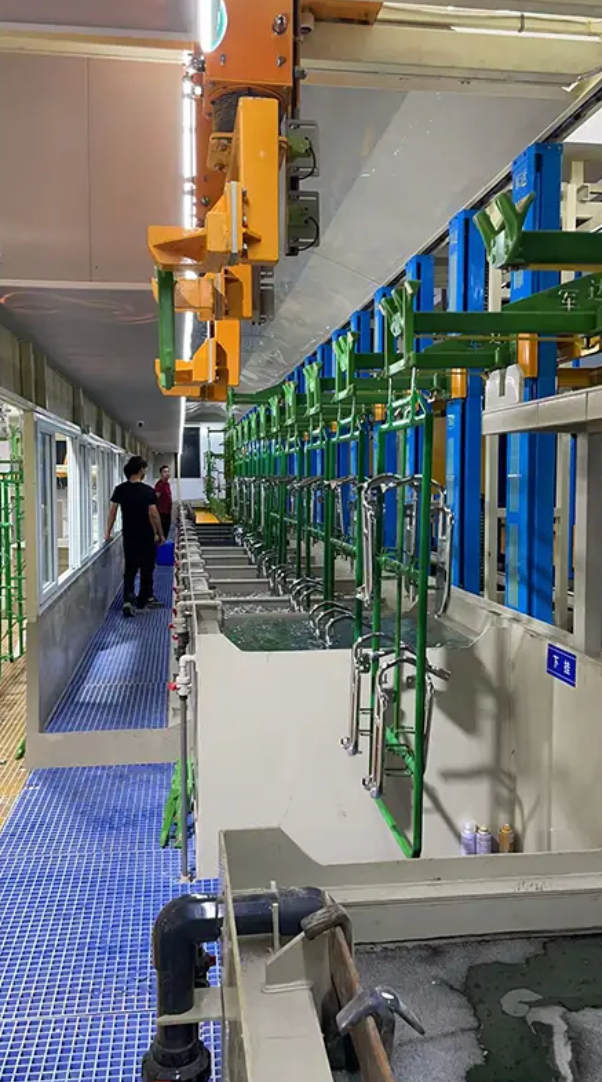
Motorcycle components rarely present flat, uniform surfaces. Brackets, footpeg mounts, brake caliper bodies, and engine covers all carry deep recesses, blind holes, sharp transitions, and asymmetrical contours. In conventional barrel plating, such parts tumble together and shield one another from the plating current, leaving thin or bare spots inside recesses while the outer edges build up excessive thickness. Vertical lift plating changes the dynamic entirely: the workpiece is held stationary on a fixture that moves straight up and down through the electrolyte, so every surface faces the anodes in a consistent orientation. This predictable motion, combined with forced solution flow, allows fresh plating chemistry to reach into corners that would otherwise remain stagnant.
The benefit becomes most apparent on features like internal threads or narrow slots. When a part is rotated or agitated in a bulk process, those cavities trap air or spent solution, creating voids or rough, nodular deposits. With vertical lift, the repeated immersion and withdrawal act like a pump, exchanging the liquid inside even the tightest geometry. At the same time, because the part is not bouncing against others, delicate edges and machined sealing surfaces avoid impact damage. Current distribution also improves: a vertically suspended part presents a more uniform anode-to-cathode distance than a randomly oriented one, which reduces the need for heavy auxiliary anodes and yields a smoother, more even coating across complex planes.
Another overlooked advantage is drainage. After plating, irregular parts often retain solution in blind holes or under overhangs, leading to staining and corrosion during drying. Vertical lift plating positions the workpiece so that gravity works for you, not against you. As the fixture rises from the tank, excess liquid runs off quickly and predictably. This accelerates rinsing and reduces drag-out, which matters when plating high-value motorcycle components where post-treatment defects can ruin an entire assembly. For geometries that defy standard racking or bulk methods, the vertical lift approach offers a level of control that simply cannot be matched by rotating barrels or static racks.
Managing Bath Chemistry for Mixed Frames, Fasteners, and Exhausts
Running a single bath for frames, fasteners, and exhaust parts means accepting that you'll never hit a perfect additive balance for all three. Fasteners drag in more iron fines from barrels, frames tend to pull brightener out of solution unevenly across large flat surfaces, and exhaust components often arrive with heat scale or residual carbon that shifts the oxidation potential of the bath. The practical fix is to stop chasing a universal setpoint and instead track consumption ratios per part family. A simple log of amp-hours per rack or barrel load, paired with a weekly Hull cell panel, tells you more than the vendor's generic top-up chart.
Contaminants behave differently depending on the mix. Zinc die-cast frames can leach zinc into a nickel bath, which quickly poisons low-current-density areas on fasteners. Iron from worn barrel media or stripped exhaust hangers will raise the bath's resistivity and force you to run higher voltage, which then burns corners on frames. Rather than dumping the bath at the first sign of haze, identify the likely source from the last three loads. If it's mostly fasteners, check for torn anode bags or broken barrel danglers. If exhaust parts preceded the problem, activated carbon treatment and a low-current dummy plate usually pull out organic drag-in before it ruins a full production day.
Temperature and agitation also need to be adjusted for the mixed workload. Exhaust parts with deep bends trap solution and create stagnant zones, so air agitation has to be strong enough to prevent staining without blowing fasteners out of their barrels. A bath running at 55°C for frames may be too hot for hardened fasteners that risk hydrogen embrittlement, so either segment the schedule or accept a slightly lower cathode efficiency and plate longer. The key is recording what actually changes in the bath, not what the manual says should change.
Cutting Drag-Out and Rework in Small-Batch Two-Wheeler Runs
Small-batch two-wheeler finishing often bleeds profit through drag-out and rework, especially when painters switch colors or chemistry more often than high-volume lines. We learned that the quickest win isn't a new booth or pump—it's controlling dwell time and rack geometry for the actual parts on the line. A shift to hollow-shaft hangers and tighter masking templates cut our rinse water conductivity spikes by nearly a third within two weeks, without touching the base process.
Rework gets trickier because small runs hide defects until the next audit. Instead of chasing every blemish, we started logging defect location against rack position and spray angle at the point of first inspection. That one change exposed a repeat pattern on left-side tank panels tied to a slightly off-level conveyor rail. Fixing the rail was a two-hour job; it removed the dominant cause of rework for three consecutive color batches.
None of this requires a full line retrofit. Short runs reward operators who treat each job as a learning loop: measure drag-out per square meter of surface, tag reworked units by root cause, and feed that back to the pre-treatment and spray settings. The result is fewer rejected shells, less pigment in the wastewater, and a schedule that actually holds because rework stops stealing capacity.
Programmable Hoist Paths for Consistent Multi-Layer Coatings
Manual hoist control introduces subtle variations in speed, dwell time, and angle that accumulate across multiple coats. Programmable hoist paths replace this guesswork with stored movement profiles that can travel the same route, pause at the same depth, and lift at the same rate for every cycle. That level of consistency is especially important when a part needs several thin layers to build up the required film thickness without runs or edge buildup.
Creating these paths usually starts with teaching the hoist a baseline route, then adjusting waypoints to match part geometry and rack spacing. Operators can set slower withdrawal speeds near tricky areas, add short pauses above the bath to allow excess coating to drain, or modify rotation points so recessed sections get proper coverage. Each recipe is saved with its own parameters, making it straightforward to switch between different part families without resetting the whole line.
The result is a coating process where the first part and the five-hundredth part see nearly identical hoist behavior. Thickness variation across a batch narrows, and the number of rejected units from sags, thin patches, or uneven cure drops accordingly. When a new coating or substrate is introduced, the path can be fine-tuned and locked in, giving process engineers a reliable way to hold tight tolerances without constant manual oversight.
What to Ask Plating Equipment Builders Before You Commit
Start by digging into the tank construction and material selection. It is easy to list stainless steel or polypropylene on a spec sheet, but that tells you very little. Ask how they handle thermal expansion at the welds, what liners they recommend for your specific acid mix, and whether they have built systems that run at the same temperature and chemical concentration you plan to use. Request a detailed breakdown of previous installations with similar bath chemistries, and pay attention to how they describe failure points rather than just successful startups.
Next, press them on the rectifier and bus bar layout. Many builders treat electrical delivery as an afterthought, but uneven current density is one of the fastest ways to ruin a new plating line. Ask who is responsible for sizing the rectifier, what ripple is expected at full load, and how the bus bar geometry will keep thickness consistent across complex part shapes. Also find out whether the design leaves room to increase current density later without replacing major copper work. If they cannot answer those questions clearly, keep looking.
Finally, get specific about support after the line is installed. Ask about realistic lead times for replacement anodes, heaters, and pump seals, and whether any critical spares are kept in-country or must be shipped from the manufacturer. Ask to speak with two references who have run the same type of line for at least a year, and when you call them, ask what broke first and how long it took to fix. That will tell you more about the builder than any polished proposal.
From Zinc-Nickel to Hard Chrome: Finishes That Survive the Road
Most drivers never think about the thin metallic layers guarding suspension bolts, brake caliper pistons, and hydraulic rods. Zinc-nickel alloy plating has become the quiet workhorse here. Unlike pure zinc, the nickel content (usually 12–15%) slows the corrosion rate dramatically, allowing the coating to hold up after years of wet winter roads and salt spray. It also sacrifices itself before the base steel starts to pit, which is exactly what you want on a part that gets blasted by gravel and water every day.
Where sliding wear is the bigger enemy, hard chrome still earns its place. Hydraulic cylinder rods and steering components rely on its high hardness—often above 900 HV—and low friction surface. The deposit builds edge retention and resists scoring, which matters when fine dirt works its way past seals. Though hexavalent chrome baths have faced tighter regulations, trivalent alternatives and careful process control keep the finish viable for heavy-duty applications.
Choosing between these finishes usually comes down to the failure mode. Corrosion-prone fasteners and brackets favor zinc-nickel. Load-bearing, constantly moving parts lean toward hard chrome. Some assemblies use both, with a chromed rod and zinc-nickel plated mounting hardware, so each surface gets the protection it actually needs.
FAQ
Motorcycle parts often have irregular shapes—think fork tubes, brake calipers, and frame brackets—that can trap air or tangle in a rotating barrel. Vertical lift equipment suspends each piece on a rack, holds it in a fixed orientation, and moves it vertically through the baths, so complex geometries get uniform current distribution and far fewer contact marks.
Depending on the bath sequence, you can run nickel-chrome for heat resistance and a bright finish, zinc-nickel for corrosion protection on steel mounts, or even electroless nickel when you need even thickness inside recessed areas like intake ports and oil galleries.
Many build the carrier racks with adjustable positions and quick-change contacts, so you can switch from triple clamps to foot pegs without retooling the whole line. Programmable hoists remember the dwell time, rectifier settings, and bath sequence for each part family, which reduces setup errors.
Look for enclosed tanks with fume extraction, multi-stage rinse cascades that cut water use, and integrated wastewater treatment for chromium and nickel. Some lines also include closed-loop chemical recovery, returning drag-out solution to the plating bath rather than sending it to drain.
Because the part hangs vertically, the distance to the anodes changes along its length. A well-designed tank uses curved or conforming anodes, auxiliary anodes for deep bores like fork lowers, and baffles to smooth the current path, otherwise you’ll see thin plating near the top and burning at the bottom.
Yes. Manufacturers offer gantry robots or shuttle systems that pick racks from a staging conveyor, dip them through the process sequence, and unload after drying. This keeps operators away from hot caustic cleaners and acid activators, and it maintains a steady cycle time even for parts with different process recipes.
Schedule weekly checks on hoist cables and limit switches, inspect rack tips for pitting that can cause poor contact, and clean anode bags before they clog. Also monitor rectifier ripple and bath temperature daily because small drifts will shift plating thickness across a batch.
Conclusion
Motorcycle parts present a tricky mix of shapes and sizes, from hollow exhaust bends to threaded fasteners and bulky frame sections. Vertical lift plating equipment earns its keep here because it lets racks move up and down through the bath instead of swinging sideways, so irregular geometries get even solution contact without trapped air pockets. Manufacturers that understand two-wheeler needs will pair this motion with programmable hoist paths, letting you fine-tune dwell time, withdrawal speed, and layer sequencing for every job. That kind of control matters when you are running small batches of mixed parts, where a single generic cycle would leave zinc-nickel uneven on a brake bracket while over-plating a clutch spring. Instead, you can dial in a separate recipe for each rack, cutting drag-out and minimizing the rework that quietly eats into margins.
Bath chemistry is another place where experience separates real plating equipment builders from general metal finishers. A line handling frames, fasteners, and exhausts simultaneously needs tight filtration, temperature control, and additive dosing that adjusts for changing surface areas. Ask the manufacturer how their vertical lift design handles anode placement and current distribution across tall, awkward parts—then listen for answers about shielding and auxiliary anodes, not just tank dimensions. Road-worthy finishes like hard chrome or zinc-nickel require precise thickness distribution, and a builder who cannot explain how their hoist path and rectifier sync up will cost you more than the initial quote. Before you commit, push for a wet test with your own parts, not a demo rack of flat coupons. That single step reveals whether the line truly manages mixed loads or just looks good on paper, and it gives you confidence that the coating will survive vibration, salt spray, and years of two-wheeled abuse.
Contact Us
Contact Person: hayyr
Email: [email protected]
Tel/WhatsApp: 8613082110525
Website: https://www.jundaelectroplating.com