

Machine Washable Movers Blanket Supplier Selection Guide for Long-Lasting Protection
2026-11-23
Finding a supplier for machine washable movers blankets often feels like a gamble—too many options promise durability but fail after a few moves. The right choice protects furniture, floors, and fragile edges, while the wrong one leaves you with shrinking fabric, frayed stitching, or poor padding. This guide cuts through the noise, focusing on what actually matters for long-lasting protection. Whether you manage a moving company or need reliable blankets for in-house logistics, Top Packaging brings a level of consistency that makes supplier selection straightforward—so you can stop second-guessing every load.
Why Some Machine Washable Moving Blankets Fail After a Few Laundry Cycles
Moving blankets tend to come apart in the wash because the construction that keeps them cheap also makes them fragile. The outer fabric is usually a loosely woven polyester blend, and the padding inside is often shredded foam or recycled fiber held together by minimal stitching. Washing machines pull at every edge, and after the second or third cycle the stitching starts to loosen. Once a seam opens even slightly, the fill shifts into clumps and the blanket stops providing even protection.
Heat is another quiet culprit. Many people toss moving blankets into a hot dryer to speed things up, but the high temperature shrinks the binding tape faster than the body fabric. That mismatch creates wavy, puckered edges that never flatten out again. In some cases the binding actually tears away from the blanket, leaving the raw edge exposed and the padding free to work its way out.
Then there's the coating issue. Some machine washable moving blankets have a light water-repellent finish that gives them a crisp, durable feel when new. Harsh detergents and repeated washes gradually strip that finish. Without it, the blanket absorbs more moisture, dries unevenly, and starts to develop a musty smell even after a normal cycle. It may still look like a moving blanket, but it won't absorb shock the way it should.
Fabric Weight, Binding, and Thread Choices That Signal Long-Lasting Protection
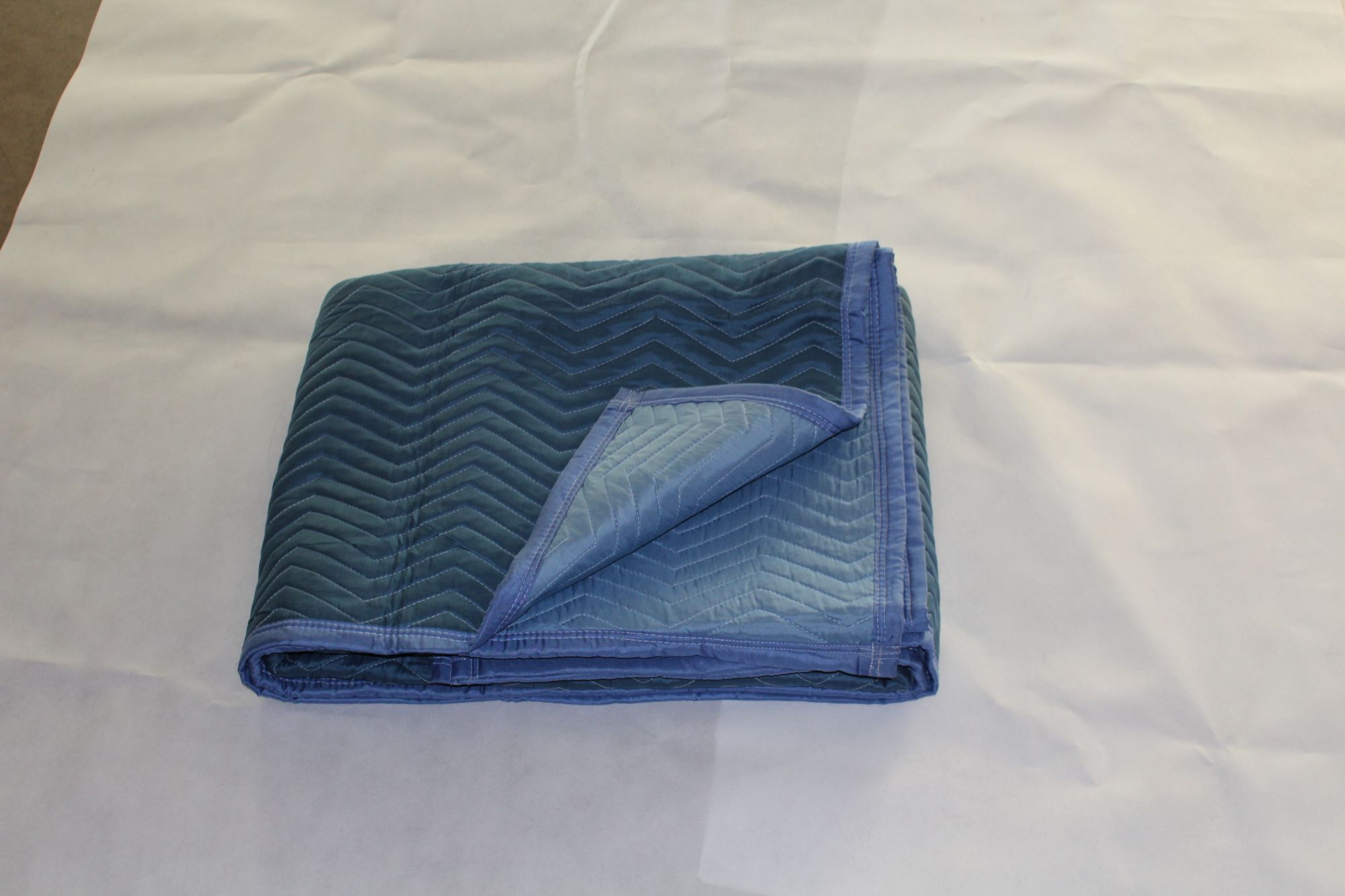
You can tell a lot about how seriously a maker takes durability by the weight of the fabric they choose. A heavier ounce-per-square-yard count doesn't just feel more substantial in your hands—it resists punctures, distributes stress across a wider area, and holds its shape after years of being dragged, folded, and exposed to weather. Look for materials with a tight weave and a slightly stiff hand; they tend to shrug off abrasion rather than fray at the first snag. Lightweight fabrics might save a few dollars at the register, but they rarely survive the kind of rough handling that separates a reliable cover from a disposable one.
Binding is where many products quietly fail. Cheap bias tape or raw, serged edges can unravel, catch on sharp corners, and let moisture creep into the seams. High-quality binding, on the other hand, wraps the edge with a folded strip that doubles the material thickness right where tearing usually starts. Run your thumb along the hem—if it feels smooth, consistent, and firmly stitched with no puckering, that's a sign someone paid attention. Double-needle or reinforced binding often signals that the maker expected the item to be stretched and pulled repeatedly without coming apart.
Thread choice is the invisible backbone of long-lasting protection. Cotton thread may look classic, but it rots when wet and snaps under UV exposure. Bonded polyester or nylon threads resist mildew, abrasion, and sunlight far better, and they maintain their tensile strength even after thousands of flex cycles. A quick test is to inspect the stitching: if the thread lies flat and tight against the fabric without gaps or loose loops, and if you can't easily pick it loose with a fingernail, you're probably looking at a product built to outlast its warranty. The best makers don't hide these details—they highlight them because they know that's where true longevity lives.
How to Verify Washability Claims Without Relying on Supplier Spec Sheets Alone
Spec sheets tend to highlight the rosiest wash cycle a fabric survived in a controlled lab, not the one your customers will actually use. A better starting point is to run your own side-by-side laundering tests on finished samples using the harshest realistic setting: warm water, a standard detergent, and a full dryer cycle. Track what changes after five and ten washes—not just fading, but shrinkage, seam puckering, hand feel, and any surface fuzzing. Those small degradations rarely show up in a supplier's summary, yet they're exactly what drives returns and complaints.
Also ask for the raw test reports behind the headline claim, not a PDF with a logo and a pass/fail box. Look for the exact method used, the number of cycles completed before the rating was assigned, and whether the fabric was tested as a finished garment or as flat yardage. If a supplier can't or won't share those details, that hesitation is data. Independent labs are cheap enough for a spot check, and even a basic AATCC or ISO colorfastness test on your own sample gives you a comparison point far more trustworthy than a marketing number.
Finally, test the failure mode early. Washability isn't only about color; it's about whether a collar curls, a bonded membrane delaminates, or a printed graphic cracks along a stretch line after repeated agitation. Put a few samples through a more aggressive home-wash simulation than the care label suggests, because consumers will. The goal isn't to prove the fabric perfect—it's to learn how it fails so you can decide whether that failure is acceptable for your product and price point.
Questions That Expose a Supplier’s Real Quality Control Habits
Most supplier audits miss the obvious because they focus on paperwork instead of watching how people react when something almost goes wrong. A useful question is to ask about the last time an inspector flagged a borderline batch and what happened after that. If the answer is a clean, rehearsed story with no mention of disagreement, delay, or rework, you are probably not hearing the full picture.
Ask whether operators can stop a line without getting a supervisor’s permission, and then ask for a recent example. Also worth asking: who reviews first-article checks, how long raw material quarantine actually lasts, and whether scrap rates are shared with the production team or treated as something to hide. The way a supplier answers these questions tells you more than any certificate on the wall.
Sampling and Testing for Shrinkage, Tearing, and Edge Wear Before Bulk Orders
Before committing to a bulk run, pulling a small cross-section from the current production batch tells you more than a supplier's word ever will. Cut swatches from different rolls or pieces, not just the top of the stack, and mark their grain direction and location. Shrinkage can hide in fabric that looks stable on the shelf, so a warm wash or steam test often reveals what a dry measurement misses. Record the percentage change in both length and width, and compare it against the tolerance you actually need for your end product rather than a generic industry number.
Tearing resistance deserves the same practical eye. A slow, steady pull may pass while a sharp snag fails, so test both a straight tear and a puncture-style start if the material will face hardware, zippers, or rough handling. Edge wear is quieter but just as costly, so fold a sample, rub the crease, run a fingernail or a smooth tool along the cut edge, and watch for fraying, coating loss, or fiber dust. If the edge starts to bloom after a few passes, that flaw will multiply across hundreds of finished pieces.
Keep the failed samples, not just the data sheet. Having a physical reference makes it easier to push back on a supplier or adjust your own finishing steps before the full order arrives. Even a small shift in coating thickness, weave density, or lamination pressure can change how a material shrinks, tears, or wears at the edge, so retest whenever the source or batch changes.
Building a Supplier Shortlist Around Replacement Costs Instead of Unit Price
Unit price often gets the most attention in a sourcing review, but it rarely reflects what a switch will actually cost the business. A supplier with a low quote can still drive up spending through late deliveries, inconsistent batches, or the extra inspection hours needed to keep their output usable. When buyers focus on replacement costs instead of the headline number, the shortlist starts to look different: the suppliers that survive are the ones whose failure or departure would not quietly drain the operations budget.
A practical way to build this into selection is to put a replacement cost estimate next to each candidate. That estimate should include re-qualifying materials, adjusting production settings, retraining staff, holding safety stock during the transition, and absorbing any downtime if the new supplier stumbles. Even a rough figure is useful because it pulls hidden switching risks out of the spreadsheet and makes them part of the comparison. A slightly higher unit price can become the cheaper option once those transition and recovery expenses are counted.
The shortlist should therefore favor suppliers with a track record of stable delivery and low switching friction, not just aggressive pricing. This shifts the conversation from chasing the lowest bid to protecting throughput and cash flow. It also gives procurement a clearer way to defend supplier choices internally, because the recommendation rests on what a replacement would really cost rather than on a number that looks good at the moment of purchase but ages poorly over time.
FAQ
Look past the label and check the construction. A long-wearing option usually uses a woven polyester-cotton face rather than a thin nonwoven sheet, with a weight of at least 12 ounces per square yard. The best suppliers will also bind every edge with heavy fabric and lock the corners with reinforced stitching, because those are the first places that tear when a blanket gets dragged across concrete or wrapped around sharp furniture legs.
Ask for wash test data instead of accepting a verbal guarantee. Request details on shrinkage after five to ten industrial cycles, fiber pilling, and whether the binding stays intact. A practical step is to order a few current-production samples, run them through a commercial washer and dryer at least three times, then compare measurements, stitching, and surface wear against an unwashed sample.
Woven poly-cotton blends generally hold up better than single-layer nonwovens because they resist tearing, release dirt more easily, and keep their shape through washing. A practical baseline is around 12 to 16 ounces per square yard for everyday furniture protection, while heavier blankets in the 18 to 20 ounce range make sense for long-distance moves, storage, or repeated commercial use.
It is one of the strongest indicators of how long the blanket will survive. Exposed raw edges fray quickly once washed and dragged, so a supplier that uses folded or woven binding on all four sides is already signaling better production standards. Double-needle stitching along the seams and reinforced corner tabs reduce the chance of blowouts when the blanket is pulled tight around heavy items.
Ask whether the supplier measures fabric weight per batch, documents shrinkage after washing, and checks seam strength during production rather than only at the final inspection. It also helps to request their acceptable defect rate and ask if they will hold an order for rework when that rate is exceeded. The most useful answer is a clear, numeric standard, not a general promise of high quality.
They are worth it when you want to reduce waste and make inventory easier to manage. A slightly larger blanket may cut down on the number of pieces needed per job, while different colors can help separate clean blankets from dirty ones or identify different crews. The main constraint is minimum order quantity, so ask whether the supplier can adjust dimensions without changing the core fabric or binding process.
Shift the comparison to cost per use rather than unit price alone. A cheaper blanket that shrinks, pills, or tears after a few washes often costs more once replacements and rework are included. Ask for a pre-production sample, confirm the exact fabric weight and blend, and clarify whether the supplier offers a replacement credit for clearly defective batches. That makes the long-term cost much easier to judge.
Be cautious when the supplier cannot provide a clear fabric weight, avoids sharing wash test results, or describes the product only as heavy-duty without explaining construction. Samples that show uneven edges, loose threads, noticeable shrinkage after a few washes, or a rough hand feel are also warnings. A reliable partner will be specific about materials, stitching, and what happens when a production batch falls short.
Conclusion
Most machine washable moving blankets look sturdy on day one, but the real difference shows after repeated laundering. Shrinkage, frayed binding, and broken threads are rarely random; they trace back to fabric weight, edge construction, and stitch selection. A supplier that uses dense woven poly-cotton, double-fold binding, and heavier bonded polyester thread will typically survive industrial wash cycles better than one relying on lighter fill and single-needle edging. Verification also cannot stop at spec sheets. Ask for third-party wash test reports, request a used sample from an actual customer, or run five to ten laundry cycles in-house before committing. Claims about washability mean little unless the blanket has already been through repeated agitation, heat, and detergent exposure under conditions that resemble your own operation.
Questions should push beyond basic certifications. Ask how a supplier tracks batch-level quality, what rejection rate they accept for edge stitching, and how they handle a failed lot after shipment. A factory that openly discusses rework, inspection logs, and returned-goods data is often more dependable than one that only recites product features. Sampling should focus on the failures you will actually pay for later: shrinkage beyond tolerance, seam tears under load, and edge wear after abrasion. Measure before and after washing, pull hard on stitched corners, and run a simple rub test against concrete or pallet edges. Finally, shortlist suppliers by replacement cost over the expected service life, not by initial unit price. A blanket that fails after six washes can cost far more in labor, downtime, and reorders than a slightly more expensive option that stays intact for years.
Contact Us
Contact Person: Shelly
Email: [email protected]
Tel/WhatsApp: 86-577-64286522
Website: https://www.topmovingpad.com/