
Custom Copper-Nickel-Chrome Barrel Plating Equipment for Consistent Metal Finishing
2026-09-18
Achieving a flawless, uniform metal finish across every barrel load is a constant challenge in electroplating. Off-the-shelf equipment rarely fits your exact production needs, leading to uneven coating thickness, wasted chemicals, and costly rework. That’s where Junda steps in—our custom copper-nickel-chrome barrel plating systems are engineered around your specific part geometry, plating volume, and finish requirements. Instead of forcing your process into a generic machine, we build the equipment that makes consistent results the default. Curious how tailored barrel plating can transform your line? Keep reading.
Barrel Plating Configurations That Prevent Uneven Copper-Nickel-Chrome Buildup
Uneven deposit buildup in barrel plating often starts with poor current distribution across the load. Parts near the barrel walls or dangler contacts receive more current than those buried in the center, leading to thick copper in some spots and thin nickel or chrome elsewhere. A practical fix is to redesign the barrel interior rather than simply cranking up the current. Using center-bar danglers in combination with auxiliary side contacts spreads the current path more evenly, while a slotted barrel with about 20–25% open area improves solution exchange without losing small parts. Load volume also matters: keeping the barrel no more than half full lets parts tumble freely into the high-current zones instead of locking into one position.
For copper-nickel-chrome sequences specifically, the gap between layers creates a different kind of buildup problem. If copper is too thick at edges, nickel tends to magnify that roughness, and chrome then highlights every defect with a dull or cloudy finish. One configuration that works well is a stepped barrel rotation pattern: slow forward tumble during copper deposition, then a periodic reverse pulse during nickel to level the surface, followed by a stationary or gentle rocking stage for chrome. This keeps the parts from banging against each other during the final bright layer while still allowing enough agitation for gas release. Adding a conforming anode basket that follows the barrel curvature instead of using flat anode bars also helps even out the field at the barrel ends, where buildup usually gets worst.
Finally, the type of dangler and its placement can make or break uniformity. Fixed button danglers tend to create hot spots where they press against the load, while flexible danglers that ride with the tumbling parts distribute contact more randomly. For barrels running mixed small and medium parts, a center cathode rod with multiple flexible arms works better than a single end contact. Pairing that with a lower average current density and a longer plating time often produces a smoother copper-nickel-chrome stack than trying to force speed with high amps. The result is a barrel load where every part leaves with roughly the same layer thickness, so the final chrome looks bright and even rather than patchy or burnt at the edges.
Agitation and Current Control for Uniform Metal Deposition
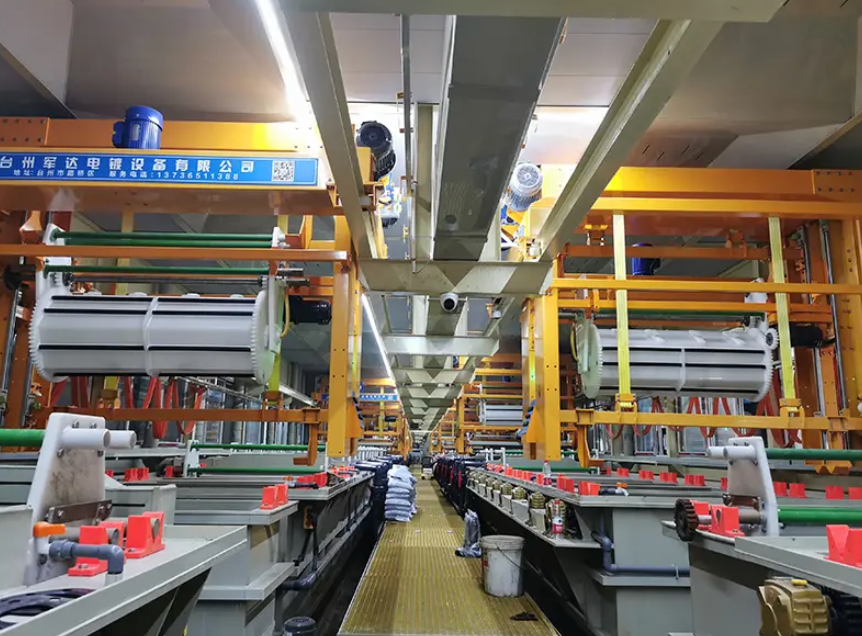
Achieving an even metal layer depends heavily on how the electrolyte moves and how electricity is delivered. Without controlled agitation, ions near the cathode become depleted, leading to thicker deposits at edges and thinner centers. Pulsed or periodic stirring breaks up the depletion zone, but the pattern matters more than the intensity. A gentle, laminar flow across the surface often outperforms violent mixing, which can introduce turbulence and uneven nucleation.
Current control is equally critical. Fixed direct current tends to favor high-current-density regions, causing dendritic growth or burnt deposits. By modulating the waveform—short forward pulses followed by brief reverse pulses—the deposition rate evens out. Reverse pulses dissolve microscopic peaks faster than valleys, effectively leveling the surface. The ratio of forward to reverse time, along with peak current amplitude, must be tuned to the specific bath chemistry and part geometry.
In practice, operators often combine both strategies. A rotating cathode or reciprocating paddle provides consistent agitation, while a programmable rectifier adjusts current density in real time based on feedback from thickness sensors. This integrated approach prevents the common failure modes: edge buildup, nodulation, and non-uniform alloy composition. Small changes in agitation frequency or pulse timing can shift the deposit from matte to bright, so careful logging and incremental adjustments are essential for repeatable results.
Lining and Material Choices That Extend Equipment Life
Rubber linings have long been the go-to for impact zones because they absorb shock without cracking. But when fine abrasion is the dominant wear mode, a ceramic lining often outlasts rubber by a factor of four or five. The key is matching the material to the failure mechanism rather than defaulting to a one-size-fits-all solution.
Polyurethane offers a middle ground in wet or sticky applications, shedding material buildup while resisting sliding abrasion. UHMW polyethylene works well where low friction matters more than high-temperature tolerance. None of these choices work everywhere, and that is the point—equipment life comes from deliberate material selection, not from a single 'premium' label.
Beyond the base material, thickness and attachment method matter just as much. Bolted ceramic tiles can be swapped in sections, while bonded rubber sheets need full downtime to replace. Planning for partial wear and easy replacement can double the effective life of a lined chute or hopper without doubling the initial spend.
Specifying a Custom Barrel Plater for High-Volume Finishing
When production volumes climb past a few thousand parts per shift, off-the-shelf barrel plating equipment rarely keeps pace. Custom barrel platers let you dictate barrel dimensions, perforation patterns, and agitation angles to match the exact geometry of your components. Instead of forcing a square peg into a round hole, you can spec a smaller barrel diameter for delicate fasteners or a wider, deeper unit for bulky connectors, which cuts down on tangling and ensures every surface gets consistent coverage.
One detail that often gets overlooked is the barrel's rotational speed and its effect on current distribution. In a custom build, you can work with the fabricator to fine-tune gear ratios and DC rectifier ramping so that high-surface-area loads don't starve the tank for amperage or burn thin edges. Also, consider specifying a split-barrel design with separate cathode danglers per compartment—this allows you to plate mixed part sizes in the same run without sacrificing thickness uniformity across the load.
Beyond the barrel itself, the surrounding tank, hoist, and exhaust system should be matched to your throughput targets. Work with the supplier to map out drain-and-rinse cycles, barrel transfer speeds, and even the type of dangler contact points that minimize arcing. A well-specified custom barrel plater isn't just a larger drum—it's a tuned module that shortens cycle time, reduces rework from shadowing or poor coverage, and lets your line hit daily output quotas without extra labor or midnight troubleshooting.
Reducing Rework Through Tighter Thickness Tolerances
Tightening thickness tolerances often feels like a costly upfront decision, but the downstream savings tell a different story. When material thickness varies beyond acceptable limits, parts fail to fit during assembly, welds don't land where they should, and fasteners either strip or bottom out prematurely. These small mismatches force operators to pause, adjust, or scrap pieces entirely. By narrowing the tolerance band, each sheet, plate, or component arrives with predictable dimensions, removing the guesswork from the build process.
Several fabrication shops have discovered that the real cost of rework isn't just labor hours, it's the disruption to workflow rhythm. A part that's too thick might require an extra machining pass, while one that's too thin can flex under load or create uneven gaps. Tight thickness control from the mill or cutting stage means that downstream operations like bending, stamping, and coating perform as intended. Instead of fighting the material, teams can keep their focus on throughput and quality checks rather than constant corrections.
The shift toward tighter tolerances also changes how suppliers are evaluated. Rather than accepting whatever arrives and grinding or shimming to compensate, manufacturers can set clear thickness limits and hold vendors accountable. This proactive approach reduces the hidden inventory of replacement parts, lowers overtime caused by late-stage fixes, and keeps projects on schedule without the frantic push that typically follows a tolerance failure. Over time, the investment in precision pays for itself through fewer rejected lots and smoother production lines.
Maintenance and Throughput Upgrades for Busy Plating Shops
Most plating lines lose hours each week to small, preventable issues that never make it onto a formal downtime report. Worn contacts on rectifiers, clogged rinse nozzles, or a slightly misaligned return-type conveyor can quietly throttle output while everyone blames the usual suspects like labor or chemistry. A practical upgrade path starts with tracking actual current density at the part surface, not just the rectifier setting, because voltage drop across old bus bars often hides a 15-20% loss in plating speed. Swapping in solid copper risers, cleaning anode hooks on a fixed schedule, and adding simple flow meters to rinse tanks can restore lost throughput without touching the bath formulation.
Another overlooked lever is the material handling sequence between stations. In busy shops, the bottleneck rarely lives inside the tank; it is the transfer time, the drip-off dwell, or the wait at a shared hoist. Retiming the hoist logic to prioritize outbound moves before inbound loads, adding a small buffer rack for finished parts, and shortening the barrel rotation pause by a few seconds can stack into an extra load or two per shift. One Midwest job shop gained 11% more capacity by rearranging the rack stripping and loading area alone, with no capital equipment spend.
Maintenance teams also benefit from shifting from reactive to condition-based routines. Instead of replacing anodes on a fixed calendar, measure their weight loss and swap only when surface area drops below a threshold. Monitor rectifier cooling fan vibration and tank temperature trends; a gradual rise often indicates failing contacts or a restricted heat exchanger. Pair these signals with a simple visual board at each line showing yesterday's actual throughput against target, and operators start flagging small issues before they become an eight-hour rebuild. The result is a line that not only runs more hours but also delivers those hours at a higher, steadier rate.
FAQ
It handles copper, nickel, and chrome plating in one integrated barrel system, tailored for parts that require a multi-layer finish.
The barrel rotation, solution flow, and current distribution are engineered for uniform coverage, so parts come out with the same thickness and appearance batch after batch.
Yes, the barrel dimensions, perforation patterns, and dangler or center-bar contacts can be adjusted to match the load size and geometry.
It works well for fasteners, stampings, small hardware, and other bulk parts needing corrosion protection and a bright decorative chrome finish.
The system can include automated hoists, rectifiers with programmable recipes, and dosing controls to reduce manual handling and process variation.
Depending on the bath chemistry, we use polypropylene, PVC, or stainless steel with appropriate coatings to resist acids and high temperatures.
It can be paired with counterflow rinses, drag-out recovery, and effluent treatment modules to keep chemical consumption and wastewater in check.
You get process engineering review, installation guidance, and operator training so the line is dialed in for your specific parts and production rate.
Conclusion
Getting a consistent copper-nickel-chrome finish out of barrel plating starts with how the barrel itself is built. Standard off-the-shelf units often trap parts in dead zones or let current density wander, which shows up as uneven copper buildup or patchy nickel coverage. Custom configurations fix this by matching barrel geometry, perforation size, and dangler placement to the parts you actually run. Add in controlled agitation—whether that's adjustable rotation speed or a rocking motion—and you keep the workload tumbling freely so every surface sees fresh solution. Pair that with rectifiers that deliver stable current ramping and you prevent the burned edges and dull centers that drive rework. The right lining matters just as much. Polypropylene or PVDF liners resist the aggressive chemistry and temperature swings, while titanium or stainless steel danglers and contacts hold up far longer than generic replacements.
For high-volume shops, specifying a custom barrel plater means thinking about how the line will run day after day, not just the initial install. Tighter thickness tolerances come from tighter process control: pulse plating options, precise amp-hour meters, and barrel-speed profiling all help hold chrome and nickel layers within a few microns across an entire load. That directly cuts rework because parts pass inspection the first time instead of circling back through strip-and-replate. Maintenance doesn't have to be a bottleneck either. Quick-change barrel assemblies, sealed bearings, and modular drive components let busy plating lines swap out worn parts during normal downtime rather than losing a full shift. Over time, upgrades like larger-capacity barrels with improved drainage or automated loading systems push throughput higher without sacrificing the consistency that keeps customers coming back.
Contact Us
Contact Person: hayyr
Email: [email protected]
Tel/WhatsApp: 8613082110525
Website: https://www.jundaelectroplating.com