

Container Refrigeration Room Evaporator Factory Selection Guide for Cold Chain Operators
2026-11-18
Choosing the right room evaporator can make or break cold chain performance, yet many operators still rely on outdated assumptions or one-size-fits-all specs. In container refrigeration rooms, where airflow, defrost behavior, and humidity control differ sharply from standard cold storage, a poorly matched evaporator quietly drives up energy costs and spoilage risk. This guide cuts through catalog noise to help you evaluate factory options that actually hold up under real operating conditions. At the core of that evaluation is PAULAIR, a brand built around precision-engineered evaporators for demanding container applications. Whether you are upgrading an aging fleet or specifying new builds, the following selection framework will help you ask sharper questions and avoid costly trial-and-error.
Does the Factory Test Bay Actually Mimic Your Defrost Conditions
It is tempting to treat a factory test bay run as proof that the defrost sequence will work in the field, but the two environments rarely behave the same way. A test bay usually has stable ambient conditions, clean airflow paths, and no real product load pulling heat out of the space. In an actual freezer or cold room, door openings introduce moisture, racking and packaging disrupt air patterns, and the evaporator coil may frost unevenly. Those differences shift where frost accumulates, how thick it becomes, and how much heat is needed to clear it.
The defrost controls themselves can also read the situation differently once the unit is installed. A factory test often uses temporary sensor placement and simplified wiring, while the installed system may have longer drain lines, different termination thermostat locations, or a coil that sits in a warmer equipment corner. As a result, a defrost cycle that looks balanced on the test bench can end too early and leave ice behind, or run long enough to push warm air into the refrigerated space.
That does not make factory testing useless; it just means the test bay is a starting point, not a replica. After installation, the defrost settings usually need to be tuned against real pull-down times, door usage, and coil condition. Checking the coil immediately after termination, watching how the drain line clears, and adjusting the fail-safe time or drip period based on observed frost return gives a far better match to actual conditions than the bench reading alone.
Why Fin Spacing and Drain Pan Slope Outweigh the Fan Curve
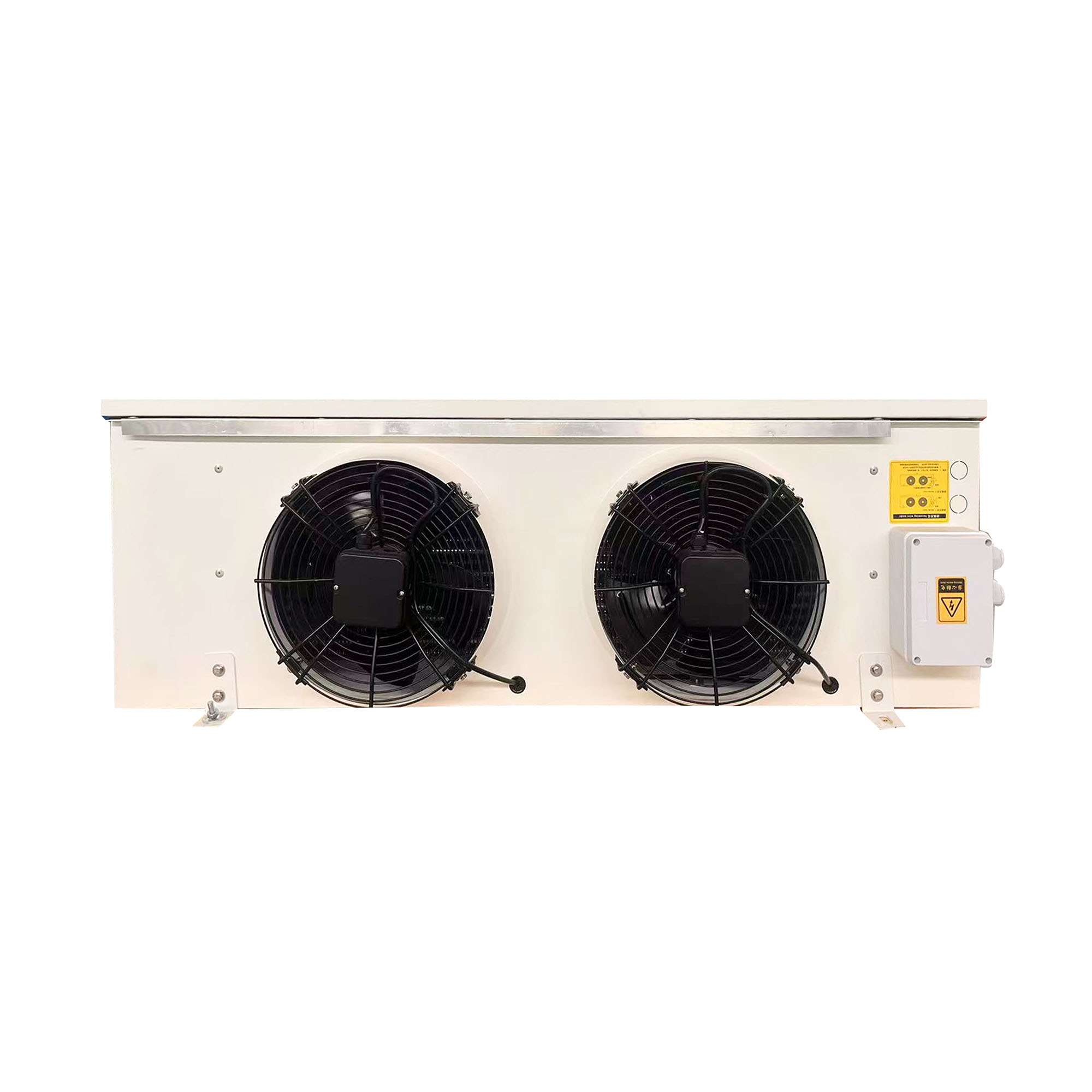
Fan curves get a lot of attention during equipment selection, but they describe a clean, dry coil operating under steady conditions. In the field, a coil that holds water behaves very differently. Tight fin spacing can trap condensate between fins, narrowing the air path and raising resistance well beyond what the published curve suggests. That moisture also creates a place for biological growth, which further degrades performance and air quality.
A drain pan with an inadequate slope makes the problem worse. Water lingers, gets pulled back into the airstream, or freezes in low-temperature applications. Fin spacing and pan slope work together: wider gaps give condensate a clear path downward, while enough slope moves it out of the pan before it can pool. Once that path is consistent, the fan only has to overcome the resistance it was actually sized for.
In practice, this means modest fan performance can still deliver reliable results if the coil drains well, while a high-static fan cannot compensate for a wet, blocked coil. Chasing a slightly better fan curve rarely pays off if the coil surfaces stay wet. Getting the drainage geometry right matters more for long-term efficiency, noise, and maintenance than squeezing another fraction of an inch of static pressure from the fan.
Loaded Room Air Throw Tells You More Than Nominal Capacity
Nominal capacity tells you what a unit can do in a test room. It does not tell you what happens after the room fills up with desks, shelves, and people. Loaded room air throw looks at how far and how evenly air moves under real operating conditions, with the heat gains and obstructions that come with daily use.
That difference shows up quickly in occupied spaces. A diffuser or fan coil can meet its rated airflow while still leaving a dead pocket near the window or forcing cold air only partway down a corridor. When throw is measured under load, those gaps become visible because the air path has to contend with actual buoyancy effects and return air patterns.
For retrofit work, loaded throw is often the sharper comparison tool. It separates units that simply move a measured volume of air from units that can place that air where people actually sit, stand, and work. A few extra CFM on paper rarely compensates for poor distribution once the room is in use.
Coastal Salt Air Exposes What Inland Specs Overlook
Salt air does not just rest on exposed metal. It drifts into seams, hinges, and small drainage channels that stay perfectly dry in a landlocked climate. A product can pass standard corrosion tests and still fail within a season near the water because the test never replicates how fine salt particles settle into still air pockets.
The same is true for fasteners and protective coatings. Galvanized steel that shrugs off rain, snow, and heat may start to pit on the side of a building that faces away from the ocean, simply because salt fog lingers there longer after the wind drops. Inland specifications rarely account for that kind of uneven exposure, so weak points appear where the original design assumed none existed.
Owners in coastal areas learn to look past the main rating and check the quieter details: ground connections, latch springs, weep holes, and the underside of fittings. Those are the spots that reveal how well a product actually handles salt air, and they are often the same spots an inland spec sheet leaves off the page.
Spot Weld and Seal Quality Before the Paint Job Distracts You
It's easy to get pulled toward the shiny topcoat, but the real story of body strength and water-tightness is written before the primer ever goes on. Walk the floor with a flashlight and look at the seams nobody photographs. Too much heat, and you have blowholes and burn-through. Too little, and the panels are just pretending to hold hands. Every inconsistent spot weld is a future creak, a fatigue crack waiting for the first hard bump, or a path for moisture to creep between layers that paint will never reach.
Then there's the sealant. A clean bead is not about appearance; it's about not trapping air, not leaving a pinhole, and not forcing a technician to hide a mistake with extra material. When the sealant is applied over a weld that's already unstable or over metal that hasn't been cleaned properly, the paint booth just becomes a very expensive way to cover up a structural lie. Check the back side of the joint, the overlap, the corners where robot programs often hesitate. Those are the spots where a good-looking exterior makes a bad process look acceptable.
The moment the paint lays down, your ability to read the metal is gone. So the discipline has to come earlier: confirm the tip dressing schedule, watch the squeeze cycles, and touch the sealant while it's still soft enough to tell you something. If you wait until the final gloss inspection to care about spot weld and seal quality, you're not inspecting the vehicle anymore. You're just admiring the distraction.
No Simulated Defrost Load Is a Reason to Walk Away
A missing simulated defrost load column on a spec sheet often reads like a red flag, but it rarely tells you anything useful on its own. Lab simulations for defrost are built around fixed air temperatures, humidity set points, and coil frost accumulation curves that do not reflect the messy, uneven frost patterns you see in a real cabinet or cold room. Walking away based on that single line means you may be filtering out equipment that handles actual defrost cycles more gracefully than a unit which scored well under artificial conditions.
The more practical question is how the system behaves once frost is present, not whether someone preloaded a test chamber to mimic it. Look instead at defrost termination controls, sensor placement, drain pan heat, and how the refrigeration circuit recovers after the cycle ends. Those details show up in wiring diagrams, sequence descriptions, and field service notes far more often than in a simulated load rating.
If a vendor does not publish a simulated defrost load figure, ask for a plain-language explanation of a typical defrost event instead. A direct answer about cycle length, temperature swing, and recovery time is worth more than a laboratory number that was produced under conditions your site will never match. That kind of conversation tells you whether the equipment is right for the job; the absence of one test metric does not.
FAQ
A dependable factory understands the thermal loads, humidity swings, and corrosion risks specific to refrigerated containers and cold rooms. They typically build coils with heavier tube walls, offer optional hydrophilic fin coatings, and validate performance under low evaporating temperatures rather than adapting comfort cooling designs.
Cooling capacity at the actual evaporating temperature, fin spacing, coil row depth, casing material, and defrost method all influence how well the unit handles moisture, frost accumulation, and frequent door openings. Airflow distribution across the coil is just as important as total capacity.
Ask to see inline leak testing, coil pressure testing, brazing inspection procedures, and batch traceability records. A credible factory will also share documented pass rates and allow a process walkthrough or third-party inspection without hesitation.
Evaporator coils in cold chain service face condensation, defrost cycles, cleaning chemicals, and salt-air exposure. Corrosion-resistant alloys and protective coatings extend service life and reduce coil replacement frequency, so the total cost over five to eight years often favours a slightly higher initial investment.
The factory should be able to adjust coil face area, connection positions, casing dimensions, fin material, and defrost heater voltage to fit existing refrigeration systems. Drawings or three-dimensional models should be shared before production, with clear revision control.
Energy efficiency should be evaluated alongside pull-down time and humidity control. An oversized or undersized coil can increase compressor runtime, frost problems, and product weight loss, so the factory's ability to match the coil to the compressor and room load is more valuable than a single efficiency label.
Expect spare parts availability for several years, clear installation and maintenance guidance, and a defined response time for technical questions. The best factories keep coil drawings and production records on file so reorders match existing units without field modifications.
Inconsistent answers about defrost performance, no experience with low-temperature rooms, reluctance to share test reports, and generic coil selections for varied climates all indicate a supplier that may be treating the evaporator as a commodity rather than a mission-critical component.
Conclusion
Start with the factory test bay. Most evaporator ratings are collected in a clean, steady-state room, which says nothing about how a unit behaves when frost builds unevenly, defrost water drains across a cold pan, and the fans restart against wet coils. A useful selection process asks the factory to recreate your actual defrost conditions: coil temperature drop, melt volume, drain pan slope under load, and the time needed before airflow returns to setpoint. Fin spacing deserves attention before the fan curve because wider gaps shed frost longer and keep air moving through a loaded room, while a steep fan curve cannot fix a coil that has already iced over. Loaded air throw measurements, taken with product in the space, reveal whether the discharge reaches the far end of the container without short-circuiting.
Coastal and humid sites add another layer that inland specifications routinely miss. Salt air works into coil coatings, bracket edges, and welded seams long before the paint job shows damage. A factory that spot welds and seals carefully, then applies a marine-grade coating, will outlast a unit that looks identical on a catalog page. Inspect those joints before paint distracts you. Finally, walk away from any supplier that cannot run a simulated defrost load with realistic water carryover, re-freeze cycles, and repeated door openings. Without that evidence, the quoted capacity is just a number. The right factory shows you the details and admits what their test bay cannot replicate.
Contact Us
Contact Person: Jack
Email: [email protected]
Tel/WhatsApp: +86-13335127698
Website: https://www.paulair-refrigeration.com