

Contactor Manufacturer: Essential Tips for Choosing a Reliable Supplier
2026-08-15
Contactors might be small, but they sit at the heart of almost every industrial electrical system. When one fails, production stops, equipment overheats, and maintenance budgets balloon. That's why choosing the right contactor manufacturer matters far more than most procurement teams realize. A reliable supplier does more than ship parts; it provides consistent quality, responsive support, and designs that hold up under real operating conditions. In this post, we'll break down the key factors to evaluate before you place an order. For those ready to skip the trial-and-error phase, ETEK has built a reputation for delivering exactly that kind of dependability.
What Separates a Dependable Contactor Maker from the Rest?
Dependable contactor makers separate themselves through load-life testing that mirrors real field conditions, not just laboratory ideals. They run endurance tests at elevated ambient temperatures, with demanding inrush currents and switching frequencies that reflect motor control, lighting, and heating loads. Instead of hiding behind optimistic datasheets, these manufacturers share failure-rate data and actively refine designs based on returned units. That kind of transparency is rare, and it signals a maker willing to stand behind every contactor that leaves the floor.
Material integrity plays an equally decisive role. High-grade silver alloy contacts, carefully molded arc chambers, and coil insulation that resists thermal aging all reduce contact welding and extend mechanical life. A dependable maker keeps tight control over its supply chain, rejecting component batches that drift outside tolerance rather than chasing short-term cost savings. The payoff shows up as consistent coil pull-in voltage, low contact resistance, and predictable performance across millions of operations.
Support after the order often reveals the biggest gap between ordinary and dependable manufacturers. A trustworthy contactor maker helps you size DC coils for low-voltage control circuits, advises on derating for hot or enclosed panels, and provides application wiring diagrams before you commit. They answer technical questions quickly, keep lead times honest, and treat repeat business as an ongoing relationship rather than a one-off transaction.
Quality Checks That Actually Matter in Contactor Production
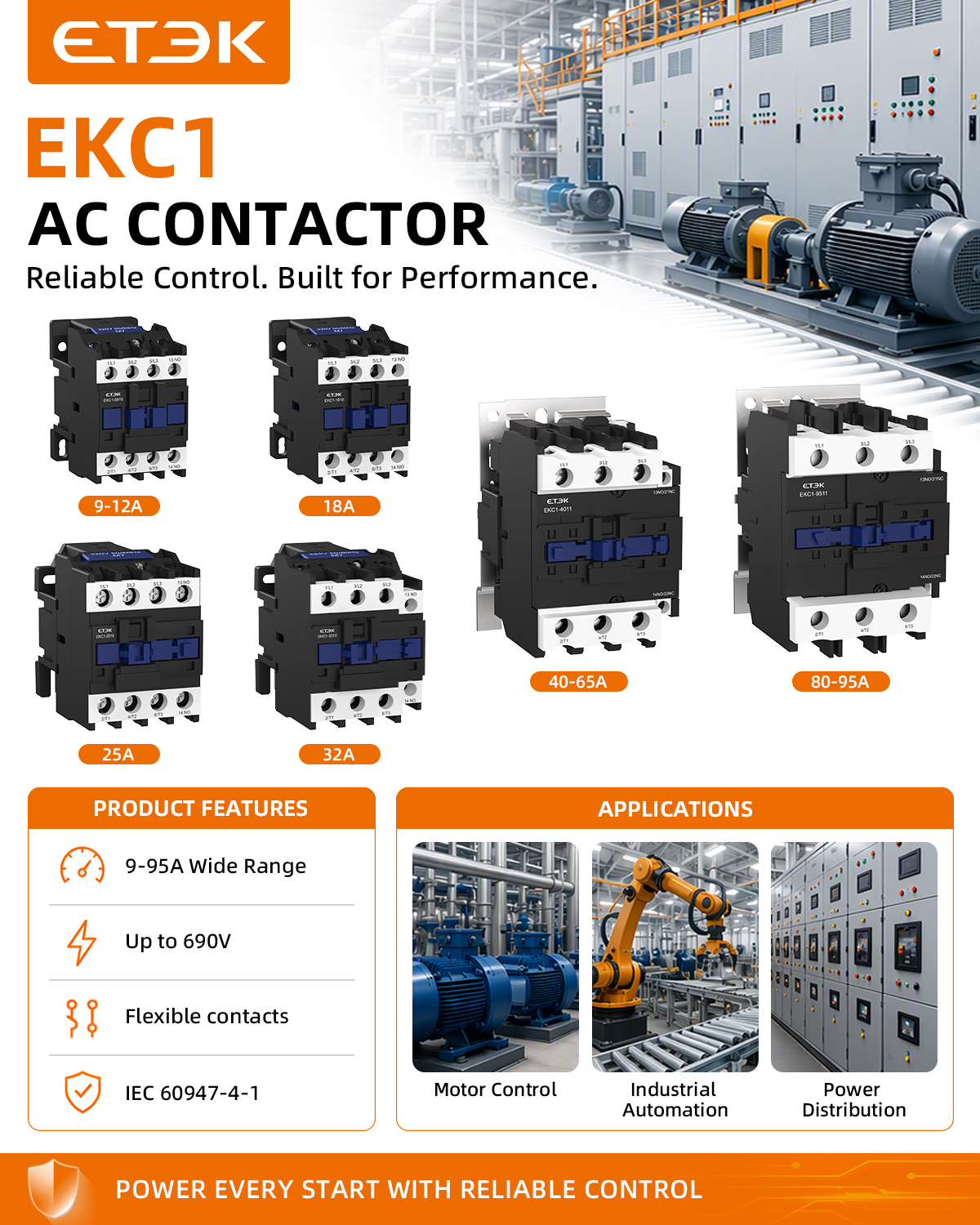
Many contactor plants run checks that look good on a wall chart but miss the failures that happen in the field. The first check that actually matters is contact resistance drift under load cycling. A cold one-time measurement proves little. The pole needs 200 make-break cycles at rated current, then a four-wire micro-ohm meter across each contact. If resistance shifts more than 8% from the pre-cycle baseline, the unit should be torn down even if it still clicks. That catches uneven wear, weak contact pressure, and poor terminal crimping long before thermal runaway shows up in the panel.
The second check is coil pick-up and drop-out voltage at elevated temperature. A coil that works on a bench at 25°C may chatter in a cabinet that reaches 70°C. Each production lot belongs in a thermal chamber at 75°C for two hours, then supply voltage is ramped down while watching for contact bounce or arcing on a scope. Any bounce wider than 3 ms is a reject. The usual culprits are armature friction or a spring that relaxes with heat. After that, a dielectric withstand test at 2U+1000 V for only 100 milliseconds separates contactors that survive motor inrush from ones that weld shut. The conventional 60-second test misses the micro-cracks in arc chutes that flash over under a real transient.
Custom Contactors: When Off-the-Shelf Won't Cut It
Many industrial applications demand contactor performance that standard catalog parts simply cannot deliver. Whether it's an unusual coil voltage, a tight space envelope, or exposure to aggressive chemicals, the one-size-fits-all approach often ends up forcing compromises in safety or reliability. When your system operates outside the typical parameters—think extreme temperatures, high inrush currents, or continuous duty cycles that would cook a stock unit—you need a contactor built around your exact requirements.
Custom contactors give engineers the freedom to specify everything from contact materials and arc suppression to terminal styles and mounting brackets. Instead of redesigning the entire panel to fit a generic component, you get a device that drops into your layout and handles the real-world load without derating. This approach not only extends service life but also cuts down on field failures and unplanned downtime, making the higher upfront cost a smart investment for critical equipment.
Supply Chain Red Flags You Can't Afford to Ignore
Most supply chain failures don't start with a loud crash. They begin with small shifts that get dismissed as one-off hiccups: a key part arrives two days late, a long-time vendor suddenly asks for shorter payment terms, or a factory manager stops answering emails on Friday afternoons. Individually, none of these feel alarming. But when you track them together, they form a pattern of instability that almost always precedes a bigger break. The suppliers who quietly move from "slightly late" to "consistently late" are usually wrestling with cash flow problems, equipment breakdowns, or labor shortages they don't want to disclose.
Another red flag is the gradual erosion of quality disguised as "minor specification changes." A supplier might substitute a lower-grade material and insist it's functionally identical. Or they might shrink the thickness of packaging to save on freight. Without rigorous incoming inspections and periodic audits, these changes slip through until a customer complaint forces you backwards. By then, the cost isn't just the defective batch—it's the trust you built downstream.
The most dangerous red flag, though, is the one hidden in your own data: inventory levels that no longer match your demand forecasts. If you're consistently carrying more safety stock for one component while another runs out unexpectedly, it often means your supplier's lead times have become unpredictable and you've been compensating without noticing. That buffer is not a strategy; it's a warning sign you've been managing around a failing link instead of fixing it.
The Real Cost of a Cheap Contactor Supplier
The upfront price tag on a budget contactor looks tempting, but it rarely tells the whole story. What you save on the invoice often comes back as unplanned downtime, emergency replacements, and overtime labor. In industrial settings, a contactor that fails prematurely doesn't just cost you the part—it can halt an entire production line.
Cheap contactors frequently cut corners on contact materials, coil insulation, and mechanical tolerances. The result is contact welding, coil burnout, and erratic switching under load. You might find yourself swapping out contactors every few months, paying for repeated service calls, or worse, dealing with damage to downstream equipment like motors and compressors. Safety risks also climb when a contactor sticks closed or arcs unexpectedly.
When you add up the hidden expenses—downtime, labor, inventory, and potential liability—the real cost of a cheap supplier far exceeds the price difference. A reliable contactor partner provides consistent quality, documented lifecycle data, and support that keeps your operations running. In the long run, paying a bit more upfront is almost always the cheaper option.
After the Sale: Support, Spares, and Warranty Realities
The handover is hardly the finish line. Once the equipment lands on your floor, the real test begins: how fast does the manufacturer answer a call, and do they actually stock the parts that wear out first? Some brands promise 24/7 support but route you through call centers that read from scripts. Others keep a local service engineer on rotation who knows the machine’s quirks by name. That difference shows up in downtime, not in the brochure.
Spare parts are where many deals quietly fall apart. A pump or a drive belt shouldn’t sit in a warehouse three time zones away while your line is stopped. Ask for a realistic list of recommended spares before you sign, and check whether those parts ship from regional stock or come “on demand” with a two-week lead time. Warranty wording matters too: some cover labor and travel, others only cover the defective component, leaving you to argue over bolts and gaskets.
Warranty claims often reveal what a company is really like. The best vendors treat a failed part as a chance to prove themselves—they send a replacement without a forensic interrogation. The worst make you photograph serial numbers, fill out three forms, and wait for a manager’s approval. Before you buy, read the exclusions line by line, and ask current users how long their last claim actually took. That’s the warranty you’ll live with, not the one on paper.
FAQ
Look beyond the datasheets. Ask for samples from their latest production batch and test them under your actual load conditions. A supplier's willingness to send fresh, unmodified samples often tells you more about their confidence than any certificate can.
They matter, but they're the floor, not the ceiling. Verify that certifications are current and cover the exact series you're buying. Then dig into their process audits—how they handle non-conforming parts often predicts the reliability of what you'll receive.
Vague lead times, reluctance to share production locations, or a sales team that can't explain derating curves are major warnings. Also be wary if they claim "equivalent to" well-known brands without providing test reports.
Not as a default. A slightly higher unit cost often buys better clipping force, more consistent coil windings, and faster replacement support. Calculate total cost of ownership, including downtime from late shipments or unexpected failures.
Ask for references from customers with similar switching cycles and environments, not just order volume. Then check how long they've manufactured the specific contactor range. Frequent redesigns can signal unresolved field issues.
It's one of the biggest differentiators. A supplier that offers application engineering help, clear failure analysis reports, and local stock for urgent replacements saves you far more than a discount on the invoice.
Dedicated manufacturers usually have deeper testing capabilities and more predictable quality for contactors. General suppliers may offer convenience, but you risk mixing batches with different internal designs. Confirm the contactor is their core product, not just an add-on.
Endurance tests under your specific voltage and motor type matter more than generic IEC categories. Request raw data on contact resistance after 10,000 and 100,000 operations. A manufacturer that hides this data or provides only pass/fail summaries probably hasn't tested rigorously.
Conclusion
Finding a dependable contactor manufacturer goes well beyond comparing price sheets. The first thing that sets a solid maker apart is transparency in how they build and test their products. A trustworthy supplier will walk you through their production floor, show you the coil winding techniques they use, and explain the contact materials they choose for different load profiles. They don't hide behind vague datasheets; instead, they openly discuss temperature rise curves, endurance cycling results, and mechanical life tests that go far beyond the bare minimum required by standards. When off-the-shelf units don't quite match your application—whether it's an unusual auxiliary contact arrangement, a specific coil voltage tolerance, or a need for reduced arc chute size—a reliable manufacturer will offer genuine custom engineering rather than just slapping a different part number on a stock design. That willingness to sit down with your engineers and develop a tailored solution is often the clearest sign you're working with a partner, not just a vendor.
On the supply side, there are quiet red flags that many buyers only notice after the damage is done. A maker that constantly shifts lead times, changes raw material suppliers without notice, or refuses to disclose their secondary component sources is quietly building risk into your production line. The upfront savings from a cheap contactor supplier frequently evaporate once you account for field failures, unplanned downtime, and the safety headaches that come from inconsistent arc interruption. Worse, after the sale, bargain suppliers often disappear when you need spare contacts, replacement coils, or a straight answer on warranty coverage. A reliable manufacturer understands that the real relationship begins at delivery: they hold safety stock for critical spares, answer technical questions within hours, and back their products with warranties that have actual teeth. In the long run, the supplier who costs a bit more per unit but stands behind every contactor is the one who protects your reputation and keeps your panels running.
Contact Us
Contact Person: Andy
Email: [email protected]
Tel/WhatsApp: +86 13356133008
Website: https://www.etek-china.com/