Bulk Rotary Engraving Material Solutions for Consistent High-Volume Engraving
2026-08-22
When every second counts on the production floor, your engraving materials shouldn't be the bottleneck. Bulk rotary engraving demands more than just volume—it demands unwavering consistency, sheet after sheet, shift after shift. That's where LYSHIRE redefines the standard: a full-spectrum material lineup engineered for high-volume rotary work, from durable plastics to precision metals. Curious how the right substrate can slash your rejection rates and keep your spindles humming? Read on—your next production breakthrough might be hiding in plain sight.
Why Material Consistency Makes or Breaks Rotary Engraving Output
Rotary engraving doesn't hide material flaws the way laser or inkjet can. The cutter follows physical resistance, so when a blank has soft pockets, hard inclusions, or uneven grain from recycled stock, the bit depth wanders. One pass can look crisp on the left and shallow on the right, and by the time you notice, the piece is already scrap. Mixed batches only amplify the problem because hardness shifts from sheet to sheet force constant recalibration.
Beyond hardness, internal stress and surface condition also break repeatability. A plate that was rolled or extruded unevenly can flex during cutting, changing groove width or leaving a wavy floor. Micro-voids in cast acrylic or tiny grain boundaries in brass cause chatter that shows up as rough edges, even with a fresh bit. If you want identical results at the end of the day, sort your blanks by batch and do a quick test cut on the corner before committing to a full run.
Picking the Right Plastic and Metal Blends for Repeat Orders
When you're reordering a plastic-metal hybrid, don't assume the next lot will behave like the first. A small shift in metal particle size or coupling agent can throw off tensile strength and impact resistance. Keep a retained sample from the approved batch, and run a quick melt flow check plus a notched Izod test on incoming material before it reaches the production line. This saves you from discovering the problem after molding hundreds of parts.
The real cost of a blend isn't on the invoice. Metal-filled polymers wear screws, barrels, and mold gates faster than unfilled grades, and that maintenance cost needs to be part of the repeat order decision. Track injection pressure or torque over time; a rising trend usually signals abrasive filler. Also agree on a fixed regrind ratio with your molder—changing it between orders alters surface finish and shrinkage, which is exactly what repeat buyers want to avoid.
A stable supply chain is just as important as the formulation itself. Ask your supplier to document any minor change in feedstock or compounding conditions, and require a certificate of analysis with every shipment. If you build a backup source, don't switch without a full trial run because even a nominally equivalent grade can alter part dimensions or bonding strength. Locking in these practices makes repeat orders predictable instead of a gamble.
How to Avoid Grain, Gloss, and Depth Shifts in Long Runs
The first step is to stop treating the material as a constant. In a long run, subtle changes in temperature, humidity, or batch consistency will creep in, and they show up first as a shift in grain or depth. Set up a sampling schedule that catches drift before it becomes visible. Check the same reference swatch every fifteen or twenty minutes, not just at the start of the shift. If you notice the surface starting to look flatter or the grain pattern getting muddy, adjust the mix or the application speed right away—don't wait for the next full inspection.
Gloss is the biggest tattletale. When the sheen starts to wander, it usually means the film thickness or the drying conditions are no longer stable. Keep a record of your solvent or thinner additions, because top-ups that seem harmless can accumulate and push the gloss up or down over the course of a run. A simple trick is to use a narrow test strip alongside the main work. Run it through the same conditions and check it under a single light source every half hour. That gives you an early warning without stopping the line.
Depth shifts are trickier because they can come from both the substrate and the coating. If you're running coated stock or pre-finished panels, don't assume every pallet is identical. Pull samples from the middle of the stack, not just the top sheet. And if you're spraying or rolling, watch the pressure and the overlap pattern—small changes in either will create bands that read as a loss of depth. The goal is to make the final piece look like it came from the same moment, not from the same recipe.
Pairing Bulk Stock with Tooling to Keep Cycle Times Steady
Operators often overlook how raw material presentation affects rhythm. When bulk stock arrives in inconsistent stacks or mixed orientations, each cycle starts with a fumble: a reach, a flip, a pause to find the next clean edge. Pairing that stock with purpose-built tooling removes those micro-delays before they compound. A simple locating nest or a pre-aligned feed rack means the operator’s hands follow the same path every time, no matter how the blanks were shipped.
The real gain shows up in the gap between nominal machine speed and actual throughput. Tooling designed around the stock’s natural resting position lets a press or brake run closer to its intended cadence without waiting for manual adjustments. Even small reductions in load time—half a second per part—add up across a shift, and because the motion becomes repeatable, cycle time stops drifting between operators.
This approach doesn’t demand expensive automation. Swapping generic storage bins for angled presentation carts, or adding a low-profile fixture that cradles each blank in the same orientation, can stabilize a process that previously relied on operator habit. The tooling becomes the standard, and the bulk stock simply feeds it.
Inventory Strategies for Engraving Shops Running Daily Volumes
Running an engraving shop that handles daily volumes means your inventory can't be an afterthought. The materials you burn through most—blanks, sheets, rotary bits—need a reorder point that matches your actual pace, not a guess. Keep a simple log for two weeks and you'll spot which items vanish fastest.
Rather than stocking everything deep, split your inventory into tiers. Fast movers get a two-week buffer; slower specialty substrates stay lean and get ordered per job. This keeps working capital from sitting on shelves while still letting you accept rush orders without a panic buy.
Talk to your main suppliers about shorter lead times or local pickup options. For shops pushing out products daily, a half-day delay in restocking can ripple through the whole week's schedule. A few extra dollars spent on reliable sourcing beats losing a customer because a common acrylic color wasn't on hand.
What to Look for in Sheet and Rod Lots Before Committing
Run your hand across the surface before you buy. Warping, scratches, or uneven thickness often hide in plain sight under warehouse lighting. Use a caliper at multiple points along the sheet or rod; variation beyond the stated tolerance will cause problems later, especially if you're machining or bonding.
Ask for the lot number and certification if the material matters for your application. Mixed lots can bring unexpected differences in color, density, or even chemical resistance. For rods, check the ends for voids, cracks, or bubbling that suggest poor extrusion. For sheets, edge smoothness and corner squareness tell you whether the cutting process was controlled.
FAQ
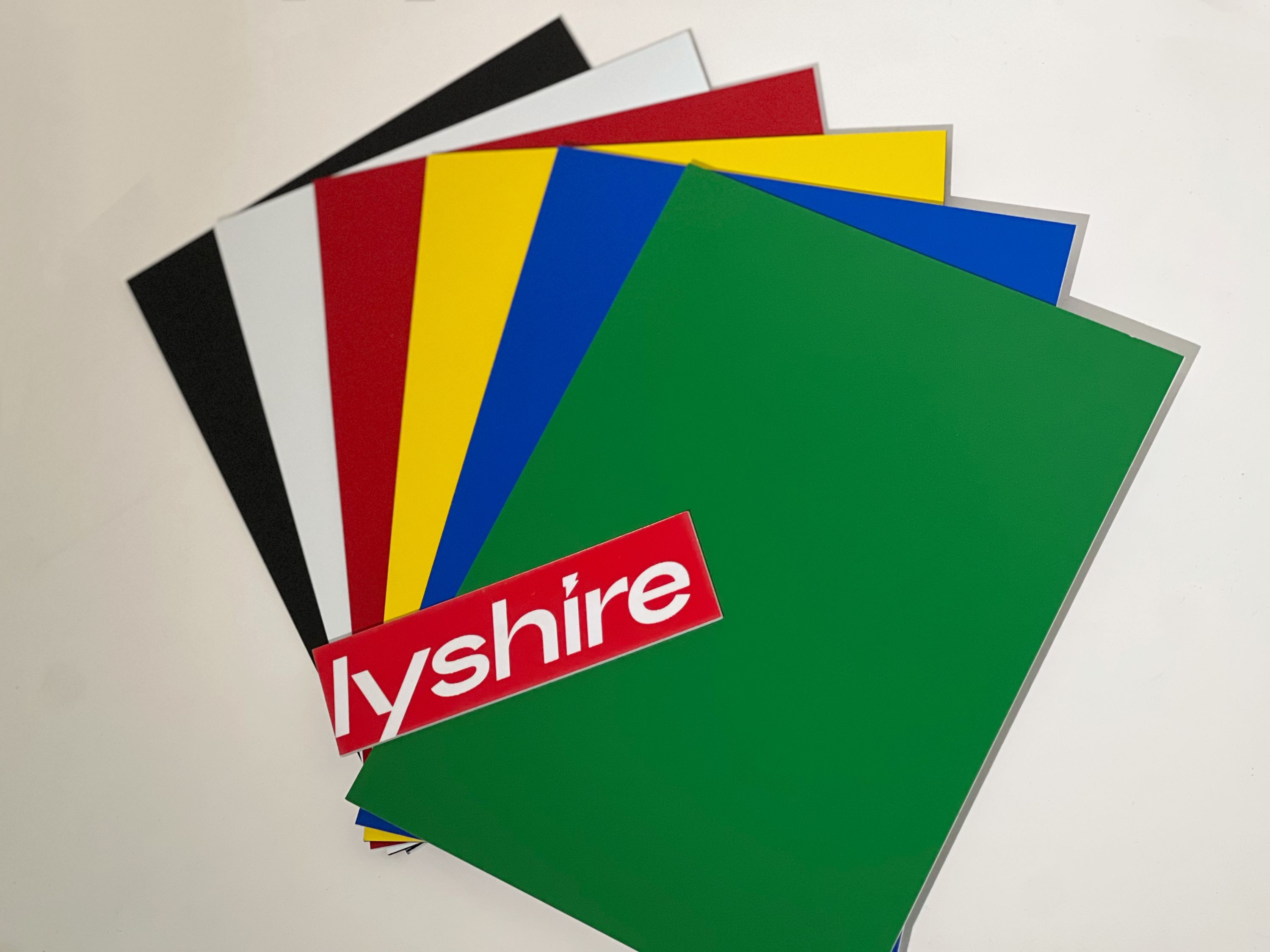
The main options include two-ply acrylic, impact-modified acrylic, ABS, and polycarbonate blends. Sheet sizes range from 12 in. x 24 in. to 24 in. x 48 in., with thicknesses between 0.020 in. and 0.125 in. Each material has a different core-to-cap contrast ratio to keep text readable at small sizes.
The polymer matrix is engineered to balance hardness and flexibility, so the cutter edge bites cleanly instead of fracturing the top layer. Thickness tolerance stays within +/-0.005 in., which reduces tip deflection and keeps chip formation predictable across thousands of parts.
Yes. Custom slitting and guillotine cutting are available for orders above a certain volume. Pre-cut blanks can be produced to your exact width and length, which cuts down on in-house handling and material waste.
Common pairings include matte black/white, red/white, blue/white, and brushed metallic caps with black cores. For outdoor use, select UV-stabilized caps that resist fading and delamination; these are rated for 5-7 years of exterior exposure depending on climate.
Most rotary-grade sheets are designed for mechanical cutting, but some polycarbonate and acrylic options can handle low-power laser cutting if vented properly. Laser can leave a tacky edge on certain cap layers, so rotary is usually recommended for cleanest results.
Each production lot is measured with a spectrophotometer and held to a Delta E below 1.0 against the master standard. For large blanket orders, we pull from a single manufacturing run and label cartons with the lot number so you can trace any sheet back to its batch.
Stock colors in standard sheet sizes typically ship in 3-5 business days. Custom cutting or non-stock color combinations add 10-14 business days. If your annual volume is stable, a blanket order with scheduled releases can hold inventory at no extra storage cost.
Bulk pricing starts at 25 sheets for standard sizes, with further price breaks at 100, 250, and 500 sheets. For pre-cut blanks, the minimum depends on piece size, but 200-300 blanks per SKU is a typical starting point.
Conclusion
High-volume rotary engraving lives and dies by the predictability of the stock on the shelf. A batch of acrylic that cuts slightly softer or harder than the last forces operators into constant speed and depth adjustments, and those small corrections show up as uneven floors, chipped edges, or inconsistent gloss across a single order. The real fix starts long before the spindle turns: buy from suppliers that document hardness, cap thickness, and color tolerance on every lot, and physically inspect incoming sheets and rods for warp, grain direction, and surface flaws. Shops that handle daily volumes can't afford to test every piece, so they lean on repeatable material specs and keep buffer stock of proven lots rather than chasing the lowest per-sheet price.
Tooling and material have to be treated as one system. A change in plastic blend or metal alloy often means re-zeroing cutters, swapping nose cones, or adjusting vacuum hold-down, and if the stock drifts mid-run, cycle times stretch and scrap piles up. Pairing bulk orders with the right cutter geometry and feed rates keeps long runs steady, while a simple incoming checklist—checking thickness at multiple points, confirming cap layer bond, and recording gloss level—prevents the kind of grain, depth, and finish shifts that customers notice on repeat orders. For engraving shops running near capacity, the goal isn't a cheaper sheet; it's stock that behaves the same at 9 a.m. as it does at 4 p.m., week after week.
Contact Us
Contact Person: Tina Hou
Email: [email protected]
Tel/WhatsApp: +86 17816238685
Website: https://www.lyshire.com