

Bathroom Bath Chair Factory Guide to Quality Shower Seating
2026-08-25
Most bath chairs look fine in a catalog. The real test happens months later, after daily exposure to soap, water, and body weight. This guide pulls back the curtain on the factory choices that separate reliable shower seating from cheap imitations—tubing gauge, joint construction, drainage, and finish. If you've ever wondered why some bath chairs creak or corrode while others stay solid, you're in the right place. Suncare has learned these lessons through years of production, and we're sharing what actually matters.
Picking a Frame That Stays Steady on Wet Floors
Look for frames with a wide stance and rubberized feet. Narrow legs concentrate pressure into small points, which makes slipping almost inevitable once water gets involved. A broader footprint spreads the load and gives the frame more surface contact. If the feet are not padded, you can add self-adhesive silicone grips, but it is better to buy a frame that includes them from the start.
Weight distribution matters just as much as the base. A top-heavy frame will tip even with good feet, so check where the heaviest part sits when the frame is empty and when it is loaded. Aluminum and powder-coated steel handle moisture well, but untreated wood can swell and throw the frame off balance over time. Run your hand along the bottom edge; any sharp metal or rough plastic can also catch on textured wet flooring and cause a sudden shift.
Seat Materials That Handle Daily Moisture Without Breaking Down
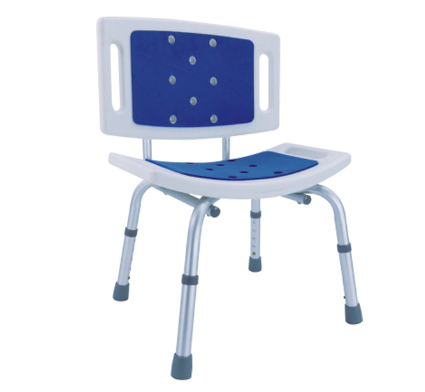
Daily moisture hits seat materials in more ways than people expect: sweat from long sits, spilled drinks, damp towels, humid air, even the residue left by cleaning wipes. Untreated cotton or basic polyester blends may feel fine at first, but they wick that moisture into foam and stitching, where mildew and frame rot start. The real problem isn't the water itself—it's the slow breakdown of adhesives, thread, and padding once dampness gets trapped. So the first rule is to pick a surface that doesn't absorb moisture deeply and a core that doesn't hold it.
Marine-grade vinyl and polyurethane-coated fabrics remain the go-to choices because they don't let liquid soak through quickly, and their UV stabilizers stop the surface from turning brittle after repeated wet-dry cycles. Look for heat-welded seams rather than stitched ones; needle holes are invisible entry points for water. Solution-dyed acrylics like Sunbrella also earn their keep—they dry fast, resist mildew, and don't rely on a plastic coating that can peel under constant flexing. For foam, closed-cell varieties are non-negotiable, since open-cell foam acts like a sponge and never truly dries out.
Pay just as much attention to what's underneath and around the material. Frames made of untreated steel or wood will swell and rust even if the cover stays dry on the surface, so choose powder-coated aluminum, stainless steel, or sealed marine plywood. Add a breathable mesh base or drainage channels under the cushion to let any trapped water escape instead of pooling. A quick wipe-down with mild soap and water after heavy use is usually enough—skip the harsh chemicals and pressure washers, because they force moisture past the surface and shorten the life of the seat.
Weight Ratings and Why They Matter More Than You Think
Weight ratings aren't just numbers on a spec sheet—they're the backbone of everything from bridge design to elevator safety, yet most people never stop to consider what those figures actually mean. When a manufacturer lists a maximum load capacity, they're not merely suggesting a guideline; they're defining the threshold where material fatigue, structural deformation, or catastrophic failure becomes statistically likely. Ignoring these limits isn't a minor oversight—it's a gamble with physics, and the house always wins eventually.
The hidden complexity behind weight ratings often surprises people. A shelf rated for 50 pounds might hold twice that for a few minutes before failing, but that doesn't mean it's safe. Engineers build in safety factors, account for dynamic loads, and test for fatigue over thousands of cycles. What looks like a simple sticker is actually the result of rigorous testing, statistical analysis, and a conservative margin designed to protect you from your own optimism.
Perhaps the most overlooked aspect is that weight ratings assume ideal conditions—level surfaces, even distribution, and no sudden impacts. Real life rarely cooperates. That's why understanding the 'why' behind the number matters more than the number itself. Once you recognize that a rating represents a boundary rather than a suggestion, you start making smarter decisions about everything from packing a moving truck to choosing the right ladder for a job.
Height Adjustments That Make Transfers Feel Effortless
Getting the height just right changes everything about a transfer. When you can match the surface to your own body's natural pivot points, the movement becomes a gentle slide instead of a lift. A few inches lower or higher can mean the difference between straining your shoulders and simply letting your legs do the work they were built for.
The secret lies in finding that zone where your hips sit slightly above the target surface. From there, you're not fighting gravity or your own weight distribution. Instead, you're using the momentum of a controlled lean, letting the equipment support you through the middle of the motion. It feels less like a procedure and more like shifting in your seat.
Start with a simple test: sit on the edge of your bed or chair and check where your knees fall relative to your hips. If your knees are higher, you'll need more effort to rise. Adjust the height until your feet rest flat and your knees sit level or just below your hips. That small tweak can turn a daily struggle into something you barely think about.
Drainage Design Details That Prevent Standing Water
Getting water off a paved surface starts with slope. A fall of 1.5 to 2 percent across concrete or asphalt sounds like very little, but it pushes runoff toward a channel drain or the lawn before puddles can form. Anything flatter than that eventually traps water in low spots caused by minor settling or formwork errors. On compacted gravel paths, a 2 percent cross slope works, though it may need occasional re-raking to keep the crown intact.
Where a slope alone cannot carry water far enough, a continuous slot drain or a catch basin with a grated top belongs at the lowest point. The slot drain works best along the edge of a patio or at the base of a downspout, because it intercepts sheet flow without creating a visible dip. For larger paved areas, multiple catch basins tied to solid pipe give water a place to go instead of relying on one undersized inlet that clogs with leaves.
Below the surface, a layer of clean crushed stone under permeable pavers or a French drain wrapped in geotextile fabric keeps the subgrade from turning spongy. The stone should be angular, not rounded, so it locks together and leaves open voids. Perforated pipe laid with the holes facing down within that stone lets water enter from below once the soil around it becomes saturated, which reduces the chance of muddy patches and prolongs the life of the base.
Assembly and Upkeep Notes From the Factory Floor
We’ve learned the hard way that the third bolt on the left-side bracket wants to cross-thread if you rush the alignment. Back it out two full turns after initial contact, then hand-start the next three before touching a torque wrench. Final pass at 42 Nm in a star pattern keeps the mating face from lifting at the rear corner.
Grease the linear rails every 400 cycles, but skip the middle two injection ports on the older jigs—those lines dead-end and just pool lubricant under the carriage. A thin film on the underside of the wear strip lasts longer than a heavy bead along the top edge. Wipe the encoder strip with a dry microfiber, never solvent, or the index marks fade within a week.
Before each shift, run a five-minute dry cycle and watch the conveyor dog spacing. If the gap drifts past 12 mm, the pickup arm hesitates at the second station and drops small washers. We keep a go/no-go bar bolted to the guardrail for that check, and it catches more issues than the morning inspection sheet ever did.
FAQ
Look at the joinery and wall thickness of the tubing. A quality chair uses reinforced aluminum or stainless steel with welded, not just riveted, corners, and the seat should resist flexing under uneven load. Check for smooth, deburred edges. Cheap units often skip that step.
Reputable factories rate chairs between 250 and 500 pounds, but the real test is dynamic load. Ask for test certificates showing the chair held 1.5 times the rated weight without permanent deformation, not just a static sticker number.
Not necessarily. High-density polyethylene or ABS with UV inhibitors can outlast foam padding in humid bathrooms. The issue is thickness and texture. Thin, glossy plastic cracks and gets slippery; a matte, textured seat around 8-10mm thick is a better sign.
Feet should be replaceable and made of non-marking TPR or similar rubber with a wide base flare. Avoid chairs where the tips are glued on; they should snap or screw into place so a worn foot does not mean throwing away the whole chair.
Request documentation for salt-spray testing on metal parts and evidence that plastic components use antimicrobial additives. Also ask for a sample chair to keep in a high-humidity room for a month. Real factories will send one without hesitation.
For home users, tool-free assembly with large hand knobs and indexed parts is safer because it reduces the chance of a loose screw later. For facilities, knock-down chairs save freight. A good guide tells you which style matches your use case.
With proper care, a mid-range to high-end chair should last five to eight years. The first thing to fail is usually the height-adjustment mechanism, so look for solid metal pins or double-locking buttons rather than spring clips.
Conclusion
A bath chair that wobbles on wet tiles isn't worth the box it ships in. Look for a frame with wide, rubber-tipped legs that bite into damp surfaces—some factory models even add cross-bracing between the legs for extra torsional stiffness. Seat material matters just as much: molded polyethylene or marine-grade aluminum holds up to daily steam and soap without cracking, while cheap tubular steel rusts from the inside out. Weight ratings often get ignored, but a chair stamped for 300 pounds might flex dangerously under 250 if the user shifts sideways. Always assume real-world loads exceed the static test.
Height adjustment isn't a luxury; it's the difference between a controlled transfer and an awkward slide. Pin-lock systems with quarter-inch increments let users match the chair to their toilet or tub rim, reducing strain on hips and knees. Drainage design is easy to overlook until you sit in a puddle: look for contoured seats with channels that slope toward a central drain hole, and avoid flat slabs that trap water against skin. From the factory floor, we see too many stripped threads from over-tightened plastic knobs—hand-tighten only, and check rubber feet monthly. A quick rinse after each use keeps soap residue from turning into biofilm.
Contact Us
Contact Person: Frank Chan
Email: [email protected]
Tel/WhatsApp: 0086-13924529088
Website: https://www.suncare-medical.com