

Aixtron G5+ GaN Epitaxy Susceptor Vendor: A Guide to Selecting the Right Partner
2026-10-31
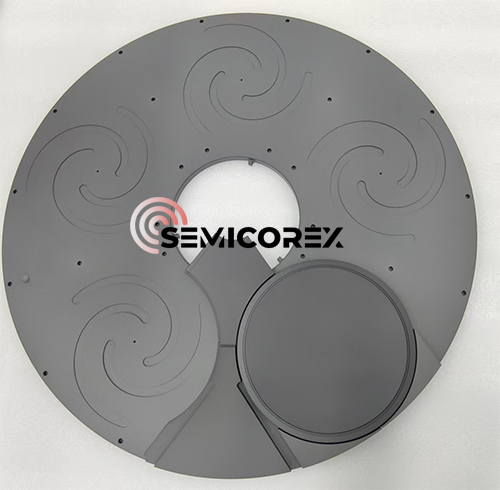
If you are running GaN epi on an Aixtron G5+, you already know that a marginal susceptor can quietly erode uniformity, particle performance, and chamber uptime before it shows up in metrology. Choosing a vendor for this consumable is not a price comparison exercise; it is a process stability decision. In this guide, Semicorex helps you cut through vendor claims and focus on the material, coating, and thermal design details that actually move yield on production-scale GaN epitaxy.
Why Your Wafer Yield Hinges on Susceptor Material Choices
Susceptors do far more than just hold a wafer during epitaxy or CVD. They define the thermal landscape every single die experiences, and small mismatches in thermal expansion, emissivity, or purity quietly convert into non-uniform film thickness, slip lines, or particle contamination. Once a batch drifts outside the acceptable window, the loss is counted in whole wafers, not just individual devices.
Material choice decides how predictably that thermal landscape repeats from run to run. Silicon carbide coated graphite remains a workhorse because it resists warping at high temperature and shrugs off most process gases, but edge-to-center temperature gradients still creep in if the coating thickness varies by more than a few microns. Bare silicon susceptors offer lower cost and easier cleaning, yet they bow noticeably above 1000°C and can induce crystallographic slip near wafer edges. Coated variants with tailored emissivity layers help flatten the profile, but only if the coating adheres without microcracks that gradually widen under thermal cycling.
The true yield lever is not just the bulk material, but how its surface interacts with the first few monolayers of deposited film. A susceptor that releases trace metals or outgasses moisture will seed defects that no amount of downstream annealing can repair. Likewise, a material with too-strong wafer sticking force increases breakage during unloading, while too-weak contact lets the wafer shift and distort gas flow patterns. Engineers who treat susceptor selection as a consumable afterthought end up chasing random yield drops that vanish only when they finally match the susceptor's thermal mass, surface roughness, and chemical inertness to the specific chemistry and temperature ramp of their process.
Reading Thermal Uniformity Beyond the G5+ Datasheet Claims
Most spec sheets stop at a single number—a temperature delta measured under ideal lab conditions. But real-world print chambers are messy: drafty corners, uneven bed heaters, and filament that behaves differently when ambient temperature drifts. If you're chasing consistent layer adhesion on a large-format G5+ build, the datasheet's thermal uniformity claim is only a starting point. You need to map the actual heat distribution across the full printable area, not just the center.
One practical approach is to run a grid of small temperature sensors or an infrared camera while the machine idles at your typical printing temperature. Note how the edges lag behind the middle by several degrees, and how the enclosure's top corners stay cooler than the bottom. Those gradients directly affect warping, stringing, and even dimensional accuracy on long parts. A printer that advertises ±2°C might easily show ±6°C variance once you measure at the extremes near the door seals and filament feed path.
Beyond measurements, consider thermal mass and recovery time. The G5+ may hold a steady temperature when nothing changes, but what happens after you open the door for a mid-print filament swap? The recovery curve is rarely published, yet it dictates whether you can still hit the claimed uniformity in a production workflow. By logging real-time data across multiple print jobs, you'll uncover patterns the datasheet never mentions—like a persistent cold spot near the purge tower or a hot zone under the LED lighting. That's the information that actually improves print quality.
Coatings That Survive Long GaN Campaigns Without Flaking
GaN deposition runs often stretch for hundreds of hours at elevated temperatures, and the chamber hardware takes a beating. A coating that holds up for a single short cycle can start shedding particles once thermal expansion mismatches accumulate. The real test is whether the interface between coating and substrate can handle repeated heating and cooling without micro-cracks turning into flakes.
We've seen that multi-layer stacks with graded composition tend to outlast single-layer coatings in long GaN campaigns. The graded layers distribute stress more evenly, so the top surface doesn't peel away when the reactor is brought down to room temperature for maintenance. Adhesion primers applied under the main coating also help, as long as they don't introduce their own weak boundary.
Flaking isn't just a cosmetic problem; loose particles can contaminate the GaN film and ruin wafer yield. So when someone asks which coating survives long GaN campaigns, the practical answer is one that balances hardness with enough ductility to absorb strain, and that has been validated over dozens of full thermal cycles in the same reactor geometry.
Matching Susceptor Geometry to the G5+ Automation Reality
Getting a susceptor to sit flat in a G5+ handler isn't just about pocket depth. The real constraint shows up at the edge profile, where automated pick-and-place arms need a predictable grip zone. If the outer chamfer drifts more than a few tenths of a millimeter from the reference design, you'll see misalignments that don't appear in manual loading tests but cascade into dropped wafers once the line runs unattended.
Another point that gets overlooked is mass distribution. G5+ robots compensate for inertial loads by assuming a certain center of gravity; changing the pocket layout or thinning the backside ribs to improve thermal response shifts that balance. The result is a susceptor that passes metrology but vibrates through fast transfer moves, leaving wafer edges scuffed before they ever reach the process chamber.
The practical fix is to treat geometry as an interface specification, not a thermal design detail. Early collaboration with the automation vendor on lift pin clearance, notch alignment, and underside flatness tends to reveal conflicts that simulations miss. On recent G5+ lines, keeping the susceptor's outer 3 mm within a tight cylindricity budget has reduced both handler faults and unplanned tool downtime.
The Overnight Call Test for Your Susceptor Vendor
Most purchasing teams assess a susceptor vendor with spec sheets, lead-time promises, and a friendly sales call. But real supply confidence shows up when something breaks at 3 a.m. and the line is down. The overnight call test is simple: before you sign a long-term agreement, call the vendor’s emergency line late at night with a plausible issue—a cracked coating, a warped baseplate, a batch showing early particle shedding. See what actually happens. Does a live engineer answer, or do you wait until business hours for a callback? Is there a local stock of replacement parts, or does every request route through an overseas middleman? These differences rarely appear in a PowerPoint.
A vendor that passes this test treats off-hours support as a designed process, not an afterthought. They will likely have shift coverage, a documented escalation path, and a habit of shipping loaner susceptors before receiving the failed one back. You can hear it in the way they ask about your chamber model and process gases instead of reading from a script. If the response is vague or centered on contracts rather than getting you running again, that is a signal worth weighing as heavily as price per unit.
Run the test with more than one vendor and compare the time to first useful action, not just the time to answer. Did they ask for photos and logs? Did they suggest a short-term workaround? Did the replacement ship the same night? When a susceptor is down, every hour of lost wafer starts costs more than most vendor negotiations save. The overnight call test strips away marketing and shows you who will actually stand behind the part when the chamber is cold and the schedule is burning.
Calculating True Cost per Run, Not Just the Purchase Price
The sticker price of a dishwasher tells you almost nothing about what it will actually cost you over its lifetime. A model that is $150 cheaper upfront might end up costing you hundreds more in water and electricity bills within just a few years. To get a true picture, you need to estimate the cost per run, which means factoring in energy consumption, water usage, and detergent, then dividing by the number of cycles you expect to run.
Start by checking the energy label for annual kilowatt-hour usage and liters of water per cycle. Multiply those by your local utility rates. For example, if a machine uses 1.05 kWh and 12 liters per cycle, and you pay $0.14 per kWh and $3 per 1,000 liters, the energy cost is about $0.147 and water cost about $0.036, totaling roughly $0.18 per run before detergent. Run it five times a week, and that's nearly $47 a year—just for energy and water.
Don't forget maintenance and lifespan. A cheap unit that breaks after five years has a much higher effective cost per run than a sturdy one lasting twelve, even if the latter costs more initially. Divide the purchase price by the estimated total number of cycles over its life, then add that to your per-cycle utility and detergent cost. That final number is the only one that matters when comparing models.
FAQ
Start with thermal and mechanical compatibility. The G5+ susceptor sits in a high-temperature, hydrogen-rich environment, so the base graphite grade, SiC coating thickness, and pocket geometry must match the reactor's thermal profile. Beyond that, look for a vendor that can provide batch-to-batch consistency data—coefficient of thermal expansion, emissivity, and surface roughness measurements—rather than just a generic certificate of conformance.
A dense, crack-free SiC coating prevents carbon outgassing and reduces particle generation during growth. If the coating is too thin or has pinholes, the underlying graphite can react with ammonia or hydrogen, releasing contaminants that degrade buffer layer quality. High-quality vendors typically use CVD SiC with a thickness of 80–120 microns and inspect for edge chipping after each refurbishment cycle.
You usually see three issues: edge-on-edge wear from repeated loading, micro-cracks in the SiC coating due to thermal cycling, and pocket deformation from uneven heating. A knowledgeable vendor will recommend a specific graphite grade, optimize the coating taper at pocket rims, and provide a refurbishment schedule based on actual reactor cycles. Some also offer thermal imaging or flatness measurement reports with each returned susceptor.
Third-party vendors often offer faster turnaround and more flexible customization—such as altered pocket depths for thicker templates or non-standard wafer sizes. However, the key is to confirm they have reverse-engineered the G5+ thermal profile properly. Ask for references from fabs running similar LED or power GaN processes. If they cannot provide those, the cost savings may not justify the risk.
At minimum, they should strip the old SiC coating without damaging the graphite base, regrind pockets to original tolerances, recoat with high-purity SiC, and perform a full dimensional and thermal shock test. Some advanced vendors also offer surface roughness mapping and flatness certification at multiple temperatures, which helps predict in-situ temperature uniformity before you load production wafers.
Ask for specific engineering documentation: drawings that include G5+ gas foil rotation features, pocket edge lift profiles, and coating thickness distribution across the top and bottom surfaces. A vendor that has actually measured temperature gradients on a G5+ will be able to discuss how their susceptor design handles the central hot spot versus the edge cooling effect. If they can't speak to those specifics, they are likely selling a one-size-fits-all part.
Typical lead times for a new SiC-coated G5+ susceptor range from 8 to 14 weeks, depending on the vendor's coating queue and whether any pocket modifications are needed. Refurbishment usually takes 4 to 6 weeks. To avoid reactor downtime, many fabs keep one spare susceptor in rotation and send the used one for recoating immediately after a preventive maintenance window.
Yes—shipping and packaging for large graphite parts can be substantial, especially if the vendor does not have a dedicated returnable crate system. Also check whether the quoted price includes final cleaning, vacuum bagging, and a certificate of cleanliness. Some suppliers charge extra for expedited coating or for detailed metrology reports. Get a full breakdown before comparing quotes, because the lowest unit price may not reflect total cost per wafer.
Conclusion
Selecting a susceptor vendor for the Aixtron G5+ GaN platform is rarely a simple procurement decision. The graphite core underneath the coating determines how quickly the pocket reaches process temperature and how evenly it sheds heat during ramp-down. Vendors often quote bulk thermal conductivity numbers, but those figures mean little if the material has uneven density or poor machining tolerances that create cold spots near the wafer edge. On a G5+ running long GaN campaigns, even a two-degree radial gradient can shift indium incorporation enough to kill wavelength uniformity across a batch. Coatings are equally critical: a well-bonded SiC or TaC layer must survive hundreds of thermal cycles without microcracking, because once flaking starts, particles become the dominant yield limiter. Ask for cross-section micrographs and thermal cycling data from the vendor, not just a glossy datasheet claim.
Beyond the material science, the susceptor has to work with the G5+ automation exactly as the original carrier does. Pocket depth, edge lip profile, and overall flatness all affect how the robot picks and places wafers, and a slightly warped or mis-machined replacement can cause repeated handling faults. The real test of a vendor is what happens at 2 a.m. on a Sunday when a new susceptor is suspected of contaminating a run. A partner who answers the phone, ships a loaner immediately, and walks your team through a root-cause analysis saves more money than any upfront discount. Finally, calculate true cost per run: divide the full price—including recoating intervals, downtime for swaps, and any yield loss during break-in—by the number of good wafers produced over the susceptor's life. A cheap carrier that needs recoating twice as often is no bargain.
Contact Us
Contact Person: Svenja Wei
Email: [email protected]
Tel/WhatsApp: +8613567891907
Website: https://www.semicorex.com